
Rajen Gala

Agro Commodity

India is predominantly anย agrarianย economy, ranking second in farm production in the world. While keeping pace with the increasing population, the growing agricultural production over the past several decades has thrown up major challenges in marketing, as well as supply, storage, and distribution. Agri commodity trading takes place via future contracts. These contracts can be used for hedging against risk or an opportunity to profit from speculation. A commodity is an essential product. Agro commodities fall into the category of soft commodities; hard commodities are usually mined products. The agri commodity markets do not exist for every agricultural product. Agri commodity trade takes place only in major commodities on six commodity exchanges in India. These products are generally cash crops. Some frequently traded products are spices, cereals, pulses, oilseeds, rubber, fibers like cotton and jute, dry fruits, etc. Commodity trading in agro products helps to develop efficient hedging and speculation strategies. For instance, if there is a marked change in future prices, because of existing spot prices, an efficient hedging strategy can be made. On the other hand, if changes in future price impact existing spot prices, an efficient speculation strategy can be formulated. Thus, on the basis of current trends in the market, it allows for finding future prices. For both retail and corporate investors, trading in agricultural commodities provides them an opportunity to diversify their portfolios. Trading in commodities has become as easy as trading in conventional stocks and securities. All you need is to open aย Demat Accountย and a Trading Account, and complete the requisite formalities. For making most of your investments in agro commodities, industry experts suggest taking into account supply and demand-based factors along with seasonal and weather-related variables. โ€œAgriculture is our wisest pursuit, because it will in the end contribute most to real wealth, good morals, and happinessโ€ – Thomas Jefferson

Agro Commodity Read More ยป

Commodity Exchange

A commodity exchange is an exchange where various commodities, agricultural and non-agricultural, tangible or intangible, including their derivate products and other raw materials are traded. The commodity exchanges in India are regulated by the Securities and Exchange Board of India (SEBI) since 2015. Prior to this, the FMC or Forwards Market Commission, overseen by the Ministry of Consumer Affairs regulated the Indian commodity exchanges. Mostly the different commodities are classified into agricultural and non-agricultural commodities. The non-agricultural commodities can be further sub-classified into three different categories – bullion, energy, and base metals. Hereโ€™s a brief list of the different types of commodities under each category that is regularly bought and sold in the exchanges. Base Metals – Aluminium, copper, lead, nickel, and zinc Bullion – Gold and Silver Energy – Crude Oil and Gas Agriculture – Black Pepper, Cardamom, Castor Seed, Cotton, Palm oil, Kapas, Wheat, Paddy, Chana, Bajra, Barley, and Sugar, among others. Most commodity markets across the world trade in agricultural products and contracts based on them. These contracts can include spot prices, forwards, futures and options on futures. There are six commodity exchanges in India. National Multi Commodity Exchange, established in 2002, Headquarter : Ahmedabad. Trading Commodities : Castor Seeds, Rapeseed, Mustard, Soyabean, Seasame, Copra, Black Pepper, Gram, Gold, Aluminium, Copper, Lead, Nickel, Zinc, Rubber, Jute, Coffee, Isabgoal,etc. Multi Commodity Exchange of India Ltd. (MCX), established in November, 2003, Headquarter : Mumbai. Trading Commodities : Metal, Bullion, Fibres, Energy, Spices, Plantations, Pulses, Petrochemicals, Cereals,etc. National Commodity and Derivative Exchange Limited (NCDEX), established in December, 2003, Headquarter : Mumbai. Trading Commodities : Cereals & Pulses, Fibres, Oil & Oil Seeds, Spices, Plantation Products,ย  Gold, Silver, Steel, Copper, Crude Oil, Brent Crude Oil, Poluvinyl Chloride, etc. Indian Commodity Exchange (ICEX), established in November, 2009, Headquarter : Gurgaon. Trading Commodities : Gold, Silver, Copper, Lead, Crude Oil, Natural Gas, Mustered, Soyabean, Soyabean Oil, Jute, Menthe Oil, Iron Ore, etc. Shariah Index, established in December, 2010, Headquarter : Gurgaon. This is the first Shariah index created in India utilizing the strict guidelines and local expertise of a domestic Shariah Advisory Board. The index comprises the 50 largest and most liquid shariah compliant stocks within BSE-500. Universal Commodity Exchange, established in April, 2013. Itโ€™s a national level electronic commodity exchange in India. Trading Commodities : Gold, Silver, Crude Oil, Chana, Rubber, Mustard, Soyabean, Refined Soya Oil, Turmeric, etc.

Commodity Exchange Read More ยป

Target Maturity

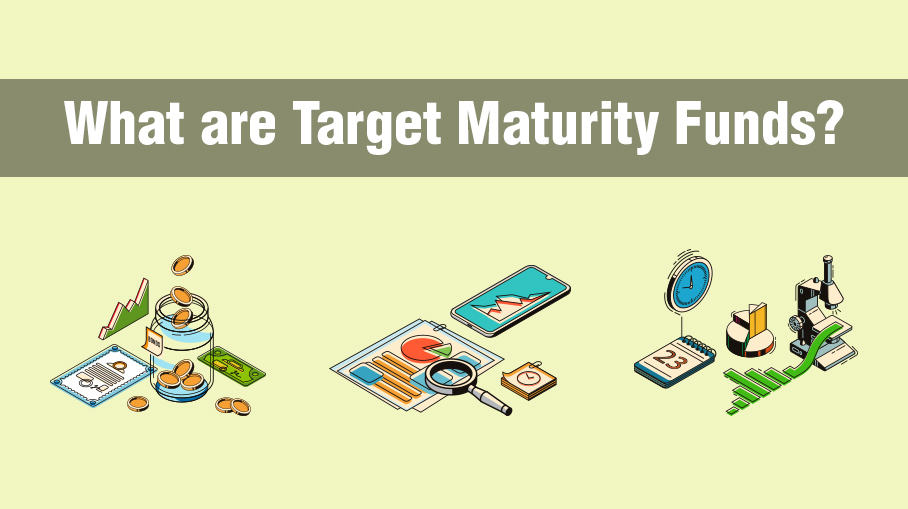
Target Maturity Funds are type of debt fund, invests in bonds of defined maturity, have gained in popularity asย  a higher return safe investment. While traditional investment avenues offer stable returns, they do not readjust with the changing interest rate scenarios on a real time basis. This is where target maturity funds can be a good fit to an investorโ€™s portfolio. Target Maturity Fund, consists of the fundโ€™s benchmark index, such as Nifty PSU bond or the Nifty SDL (State Development Loans) Index. These Funds are high in credit quality, but unlike bank fixed deposits, they are not immune to interest rate risk. Such type of funds, carry lower interest rate risk and provide more predictive and stable returns. These funds have no default risk since the investment is in government securities and highly rated bonds of public sector companies. ย Are target maturity funds an alternative to fixed deposits? You can invest in target maturity funds if you fall in the higher income tax brackets. It is taxed similarly to debt-oriented funds. It makes your investment in target maturity funds tax-efficient as compared to bank fixed deposits. If you hold investments for as long as 3 years and above it will be taxed at 20% with the indexation benefits. You may invest in target maturity funds instead of fixed deposits only if it matches your investment objectives and risk tolerance. You may avoid these funds if you cannot hold them until maturity or fall in the lower income tax bracket. Before investing in a target maturity fund, you must know the disadvantages. They donโ€™t have any historical performance to understand its past performance. Mutual Funds are open Ended means investor can exit anytime. However, if investors exit before maturity, they could be affected by the interest rate risks. This investment is only for those who are looking for not taking lot of risks. Since target maturity funds track an underlying index, fund managers donโ€™t have much scope to adjust the portfolio based on the changes in interest rates or to cash in on high NAV. You need to understand certain points before investing in Target Maturity Funds. Currently Indiaโ€™s economy is in the state where there may not be any rate cuts by RBI. If RBI increases the interest rates further. Then the prices of the existing bonds could go down, and if you exit prematurely, you may incur a loss. Investors must diversify their holdings in target maturity funds that may be emerging with higher returns. Target Maturity Funds are ideal for those who want return predictability for a certain period, that is, conservative investors.

Target Maturity Read More ยป

Decisive Parenting

From the moment a child is born, parents wonder about the role they will play in shaping their childโ€™s outlook on life. School admissions donโ€™t decide the course of just the childโ€™s life. They significantly impact the parents lives as well. Raising a child is not just an emotional and physical investment for parents, but itโ€™s a big financial obligation also. With the cost of education, health and food increasing, raising a child is costlier than ever in India. Parents always want the best for their children. This involves providing for their financial future for bigger needs like their Primary, Secondary Education, their Higher Education, their other goals, and to get them off to a good start in life. Every child has a right to decide his/her future and live out their dreams. However, with the growing costs, this may come out as a heavy burden on the parents. Education inflation is increasing by 15% to 20% every year, and simple savings accounts are too short to cut on those expenses. But this would be possible only if you invest wisely in the present. Investing should start as soon as it is financially viable. The older the child, the greater the expenses. Hence, it becomes important that parents plan for their childrenโ€™s future needs early on and give sufficient time for these investments to grow.ย The earlier you start, the greater are the benefits you will reap. For instance, if you start saving and investing as soon as your child is born, imagine the corpus you can accumulate when he/she reaches the age of 18. Financial discipline is one of the most critical factors to meet your long-term financial goals, and financial planning for a childโ€™s future. It requires meticulous planning as well as a sustained approach to build a corpus, keeping in mind the nature and variety of expenses involved. Whatever you choose as an investment option, make sure it is consistent and regular. Mutual Funds provide a brilliant option to address this by way of a Systematic Investment Plan, popularly called SIP. The other important aspect of investing is to not get influenced by market noises and stay on course with your investments. Conclusion: While you can\’t always control your own situation or your child\’s, taking these steps is a great way to set contingency plans for a variety of financial obligations that may affect you in the future. Creating long term financial plans and goals can help achieve financial stability for your family, especially through the years that your child depends on you the most.

Decisive Parenting Read More ยป

Pass Through Certificate

Pass Through Certificates (PTCs) are issued by banks as a safeguard against risks. Simply put, the banks, through PTCs, transfer some of their long-term mortgaged assets (receivables) on to other investors like NBFCs and Mutual Funds. Why do they do this? They do this because they want to share some of their risks with other players. They also do this to release capital & book profits. Investors get interested because they stand to earn more for sharing the risk. The transfer is done by means of a Special Purpose Vehicle (SPV) which mediates between the investor and borrower. The PTC ensures that the loan re-payment is made to the investor instead of the bank. Thus, the borrower is accountable to the investor instead of the bank. What happens ifย  the borrower starts to default? If the borrower starts defaulting, the SPV sells off the mortgaged asset and recovers the money. PTCs are also used to ensure that banks maintain their liquidity as per the statutory guidelines of the Reserve Bank and at the same time continueย lending. To Sum Up What: Pass Through Certificates (PTCs) are instruments of investment issued by banks. Why: It provides the bank a tool for hedging risks. When: They are issued when the bank feels it has too many risky assets to hold on to or when it needs additional capital for lending. How: The transfer is done by means of a Special Purpose Vehicle or SPV which mediates between the investor and borrower.

Pass Through Certificate Read More ยป

Off Balance Sheet

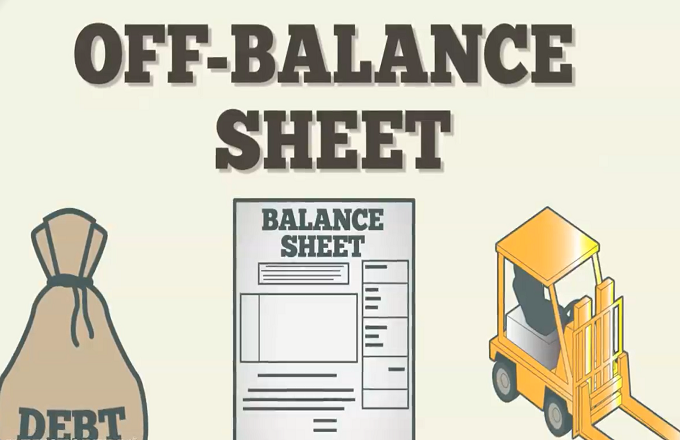
An Off-Balance Sheet (OBS) usually means an asset or debt or financing activity that is not reflecting on a company\’s balance sheet. In other words, it is a form of financing in which large capital expenditures are kept off a company\’s balance sheet through various classification methods. Companies will oftenย use off-balance sheet financingย to keep their debt to equity (D/E) ratios low, especially if the inclusion of a large expenditure would give them a negative debt to equity ratio. So, what is the difference between an on and off-balance sheet? The formal accounting distinction between on and off-balance sheet items can be quite detailed and will depend to some degree on management judgments. But in general terms, an item should appear on the company\’s balance sheet if it is an asset or liability formally owned by the company or if the company is legally responsible for it. Uncertain assets or liabilities must also meet tests of being probable, measurable and meaningful. For Exampleโ€ฆ Say company A has a subsidiary company B & it offloads all its risky investments in it. Now, any potential losses of the subsidiary company do not reflect in the books of records of the parent company. This helps A to appear financially more stable in the eyes of the public. But it also becomes responsible for any losses that arise in company B. This however is something the public doesnโ€™t know. What company A does is that it puts the risky ventures of its subsidiary company B & any resulting payment/expenses/losses out of its balance sheet & appears healthier. Companies have used off-balance sheet entities responsibly and irresponsibly for some time. These separate legal entities were permissible underย tax laws so that companies could finance business ventures by transferring the risk of these ventures from the parent to the off-balance-sheet subsidiary. Nowโ€ฆ This was also helpful to investors who did not want to invest in these other ventures. Since the Enron scandal, however, General Accepted Accounting Principles (GAAP) allow these items, whether justifiable or not, to be excluded from the parent\’s financial statements but usually they must be described in footnotes. Giving you another exampleโ€ฆ We had discussed the concept of โ€˜Oil Bondsโ€™ in one of my earlier lessons. Oil bonds are paid by the Govt. to oil companies to fund the subsidy on petroleum products. Now, a bond is a promise to pay at a later date. Thus, although the oil companies are paying money upfront for purchases, they are being compensated by means of oil bonds which is a deferred payment. Alsoโ€ฆ Besides the oil companiesโ€™ losses, the Govt. too has to pay up the money at the end of the stipulated time period which often could be a few years later. Thus, what these bonds are doing is just postponing the losses, which have to be repaid someday. And somewhere, at some point in time, the promised doles met out earlier will also eat into the Govtโ€™s revenues, thus adding to the fiscal deficit. But hereโ€™s the catchโ€ฆ Did you know that the Govt. does NOT incorporate oil bonds in its balance sheets? What this means is that while the Govt. is liable to pay oil companies at some point in time but this is not reflected in its books of accounts. Simply put, in contrast to loans, debt and equity; the oil bonds do not appear on the balance sheet for the current year as they are future liabilities. This makes the balance sheet appear healthier. To Sum Up What: An Off Balance Sheet (OBS) usually means an asset or debt or financing activity that is not reflecting on a company\’s balance sheet. How: It was permissible underย tax laws so that companies could finance business ventures by transferring the risk of these ventures from the parent to the off-balance-sheet subsidiary. Why: Tax laws allow these items to be excluded from the parent\’s financial statements but usually they must be described in footnotes.

Off Balance Sheet Read More ยป

Mark to Market

Accounting rules are the favourite whipping boys of the financial market during bad times. These days too, it is the presence of what is called โ€˜the mark-to-market accounting ruleโ€™ that is being touted as one of the culprits behind much of the write-downs seen in the financial market. However, before forming any opinion letโ€™s try to understand how the mark-to-market accounting rule works. So, what is a mark-to-market accounting rule? Mark-to-market is a very simple and straightforward accounting rule that prescribes a method for finding out the fair value for all kinds of financial assets. The list of financial assets, as you know, is fairly long – all your stocks, bonds, options, swaps, etc. can be called financial assets. How, you may wonder, does the mark-to-market accounting rule apply to so many different kinds of financial assets? Simply putโ€ฆ the mark to-market accounting rule relies on the use of the current market price of your financial assets to arrive at their fair value. Soโ€ฆ So, if you are holding a stock that is currently trading at Rs.100/-, then as per the mark-to-market accounting rule, the fair value of your stock is Rs.100/-. You may have actually acquired the stock by paying Rs.200/- and expect that one day the same stock would trade at a much higher price. But in the realm of the mark-to-market accounting rule, future expectations do not play a role. Thereforeโ€ฆ The worth of your asset is always determined by the price at which you can currently sell it in the market. There is no need to look at any other statistic like future earnings, growth potential or any other fact or fiction surrounding your financial asset. Even a blindfolded man can know the fair value of any financial asset by just using the current market price as the yardstick. Howeverโ€ฆ Many skeptics believe that while this may sound good in theory, in reality the free play of market forces may not always reflect the correct price of a financial asset. Sometimes the scale of the market may excessively tip to one side or the other, moving prices away from where they should be. For instanceโ€ฆ Distress sales hardly give any chance of selling your asset at the right price. In the worst case, as the experience of the subprime crisis showed, the financial market itself may freeze completely, leaving you with assets for which there are absolutely no takers. In such situations, the mark-to-market accounting rule may become a messenger of death even when your financial assets are generating some income. Then what conclusion can we draw? Should we completely discard the mark-to-market accounting rule when the financial market is in distress? Wellโ€ฆ We canโ€™t accept the mark-to-market accounting rule as the last word on valuation of financial assets. Neither can we completely dump the mark-to-market accounting rule. We definitely need to strike a balance. The main attraction of the mark-to-market accounting rule lies in its simplicity and objectivity. The mark-to-market accounting rule compels us to look at the real picture. To Sum Up Mark-to-market is a very simple and straightforward accounting rule that relies on the use of the current market price of your financial assets to arrive at their fair value. Many skeptics believe that the mark-to-market rule does not reflect the effect of market forces on the correct price. But, barring extreme situations, the mark-to-market accounting rule still has the potential to become the best friend of our financial market.

Mark to Market Read More ยป

Long Term Debt Funds

Understanding why one moves into long term debt funds when interest rates begin to fall. Everyone knows that prices rise when there is increase in demand and fall with the fall in demand. The same is applicable to Bonds with long durations. Letโ€™s revisit the basics of Bond price and Interest relationship: When Interest rates rise, price of bonds fall. Likewise, prices rise with a fall in interest rates. Meet the typical Indian middle-class housewife who manages her house efficiently with the money that her husband gives her. When she expects the price of vegetables to rise, she decides to purchase large quantities of vegetables for use over a longer period. Now, even if the price of vegetables were to go up, it would not make a difference to her as she had purchased for a longer duration because of her expectations that prices are set to rise. Similarly, when interest rates are expected to come down,ย  it means that the demand for bonds yielding higher interest rates would increase. Also, the supply of bonds with higher interest rates will come down. Therefore, the price of such bonds would go up. So, a smart fund manager would buy such bonds for a much longer duration so that he can gain from the increase in the price when interest rates go down as per his expectation. Thus, whenever interest rates are poised to fall it makes ample sense to buy funds that hold papers of longer duration. Going back to our housewife example. What do you think she will do when she expects supply of vegetables in the market is likely to go up? When supply is expected to go up, prices would come down. Hence the housewife does not buy vegetables for the long term any more. She just buys enough for a day or two so that she can take advantage of the falling prices. Similarly, when a fund manager expects interest rates to rise, he realizes that the prices of bonds are set to fall because of higher supply. So, he sells long duration papers and moves into short duration papers. This is exactly like what the smart housewife did when she purchased vegetables for a day or two. Both their objectives being the same, i.e., to have the money to buy at the right time. Therefore, when one is expecting interest rates to rise, it makes sense to invest in funds like Short Term Bond Fund which invests in papers of shorter duration. This ensures that you are prepared with money to buy when the prices start to falling.

Long Term Debt Funds Read More ยป

Hedge Fund Vs Mutual Fund

Hedge funds are like mutual funds in some ways. Investment professionals in a hedge fund pool in money from investors to be managed,ย  exactly like the mutual funds do. And, subject to some minor restrictions, investors in hedge funds can withdraw their money as they can in a mutual fund. Nothing else is similar. In India a number of large hedge funds operate as Foreign Portfolio Investors and these include names like Amansa, Helios etc. The world of mutual funds is much simpler while the world of hedge funds is a lot more esoteric. Let us understand how are hedge funds different from mutual funds? Hedge Funds Focus on absolute returns. Mutual Funds Focus on relative returns. Returns should be higher than benchmark. Hedge Funds Can invest in any asset class – stocks, bonds, commodities, real estate, private partnerships, – or exotic debt products like packaged sub-prime mortgages. Mutual Funds Work within a risk controlled and compliance framework set up by the regulator. Hence very risky asset classes are prohibited for investment. Mutual Fundย is essentially a trust which pools the savings of millions of small and medium sized retail investors. Hedge fund, on the other hand, is a portfolio of investments in which only a few wealthy and qualified investors are allowed to invest. Hedge Funds can borrow to bet bigger and enhance returns. Mutual Funds can borrow โ€“ but within SEBI guidelines. Hedge Funds can run highly concentrated portfolios. Mutual Funds objective is to protect investorsโ€™ investment and hence diversification is the key principle. Hedge Funds is meant for those who are already rich. Hedge funds are open only to \’accredited investors\’ defined as those with big net worth, or income in each of the past two years. Mutual Funds is meant for people at large providing them with an option of building wealth through equity and debt investments. Mutual Funds allow even small investors to participate. Hedge Funds are virtually unregulated. Mutual Funds are heavily regulated because investor safety is the most important requirement. Hedge Funds cannot market themselves publicly. Mutual Funds are sold as products to enhance wealth.

Hedge Fund Vs Mutual Fund Read More ยป

How to read Factsheet

Application Amount for Fresh Subscription : This is the minimum investment amount for a new investor in a mutual fund scheme. Minimum Additional Amount : This is the minimum investment amount for an existing investor in a mutual fund scheme. Fund Manager : An employee of the asset management company such as a mutual fund or life insurer, who manages investments of the scheme. He is usually part of a larger team of fund managers and research analysts. Entry Load : A mutual fund may have a sales charge or load at the time of entry and/or exit to compensate the distributor/agent. Entry load is charged at the time an investor purchases the units of a mutual fund. The entry load is added to the prevailing NAV at the time of investment. For instance, if the NAV is Rs. 100 and the entry load is 1%, the investor will enter the fund at Rs 101. Note: SEBI, vide circular dated June 30, 2009 has abolished entry load and mandated that the upfront commission to distributors will be paid by the investor directly to the distributor, based on his assessment of various factors including the service rendered by the distributors. Exit Load : Exit load is charged at the time an investor redeems the units of a mutual fund. The entry load is added to the prevailing NAV at the time of redemption. For instance, if the NAV is Rs 100 and the exit load is 1%, the investor will redeem the fund at Rs 99. SIP : SIP or systematic investment plan works on the principle of making periodic investments of a fixed sum. It works similar to a recurring bank deposit. For instance, an investor may opt for an SIP that invests Rs 500 every 15th of the month in an equity fund for a period of three years. NAV : The NAV or the net asset value is the total asset value per unit of the mutual fund after deducting all related and permissible expenses. The NAV is calculated at the end of every business day. It is the value at which the investor enters or exits the mutual fund. Benchmark : A group of securities, usually a market index, whose performance is used as a standard or benchmark to measure investment performance of mutual funds, among other investments. Some typical benchmarks include the Nifty, Sensex, BSE200, BSE500, 10-Year Gsec. Total Return Index : Total return index calculation considers the actual rate of return of an investment or a pool of investments over a given evaluation period. Total return includes interest, capital gains, dividends and distributions realized over a given period of time. Alpha : Alpha is the excess return on an investment, relative to the return on a benchmark index. CAGR : CAGR (Compound Annual Growth Rate) is the annual rate of return on an investment over a specified period of time, assuming the profits were reinvested over the investmentโ€™s lifespan. Yield to Maturity : The Yield to Maturity or the YTM is the rate of return anticipated on a bond if held until maturity. YTM is expressed as an annual rate. The YTM factors in the bond\’s current market price, par value, coupon interest rate and time to maturity. Modified Duration : Modified duration is the price sensitivity and the percentage change in price for a unit change in yield. Standard Deviation : Standard deviation is a statistical measure of the range of an investment\’s performance. When a mutual fund has a high standard deviation, it means its range of performance is wide, implying greater volatility. Sharpe Ratio :ย The Sharpe Ratio, named after its founder, the Nobel Laureate William Sharpe, is a measure of risk-adjusted returns. It is calculated using standard deviation and excess return to determine reward per unit of risk. Beta : Beta is a measure of an investment\’s volatility vis-โœ“-vis the market. Beta of less than 1 means that the security will be less volatile than the market. A beta of greater than 1 implies that the security\’s price will be more volatile than the market. AUM : AUM or assets under management refers to the recent / updated cumulative market value of investments managed by a mutual fund or any investment firm. Holdings : The holdings or the portfolio is a mutual fund\’s latest or updated reported statement of investments/securities. These are usually displayed in terms of percentage to net assets or the rupee value or both. The objective is to give investors an idea of where their money is being invested by the fund manager. Nature of Scheme : The investment objective and underlying investments determine the nature of the mutual fund scheme. For instance, a mutual fund that aims at generating capital appreciation by investing in stock markets is an equity fund or growth fund. Likewise, a mutual fund that aims at capital preservation by investing in debt markets is a debt fund or income fund. Each of these categories may have sub-categories. Rating Profile : Mutual funds invest in securities after evaluating their creditworthiness as disclosed by the ratings. A depiction of the mutual fund in various investments based on their ratings becomes the rating profile of the fund. Typically, this is a feature of debt funds.

How to read Factsheet Read More ยป