
Debt

What Is SIF?

🌟 What is SIF (Specialised Investment Fund)? — Simple Explanation A SIF is a type of investment fund designed mainly for experienced or professional investors, not for everyday retail customers. Think of it like a private investment club meant for people or institutions who understand financial risks—such as wealthy individuals, family offices, banks, insurance companies, or large investment firms. 🧱 Key Features — Explained Simply 1️⃣ For Experienced Investors Only A SIF is not open to the general public.Investors must meet certain criteria (knowledge, wealth, or professional status). 2️⃣ Flexible Investment Rules SIFs have very flexible regulations, meaning they can invest in many types of assets, including: This makes SIFs attractive for sophisticated investment strategies. 3️⃣ Supervised by Luxembourg Regulator (CSSF) Although flexible, a SIF is monitored by the financial regulator in Luxembourg (CSSF).This adds credibility and safety, compared to unregulated funds. 4️⃣ Diversification Requirement A SIF must not put all money into one single asset.It must spread investments to reduce risk. 5️⃣ Tax Advantages A SIF usually pays very low taxes in Luxembourg, mainly: This is why many international investors choose Luxembourg. 6️⃣ Flexible Setup A SIF can be structured in different ways, for example: It can also have multiple sub-funds inside one umbrella structure. 💡 In One Sentence A SIF is a flexible, low-tax, professionally regulated investment fund in Luxembourg, created for experienced investors who want to invest in a wide range of assets. 🧭 Want More? If you want, I can also explain:✅ How SIF compares to RAIF✅ Requirements to set up a SIF✅ Who qualifies as a “well-informed investor”✅ Advantages & disadvantages Just tell me! You said: SIF Specialised Investment Funds details Explained in Simple language – blog ChatGPT said: Below is a simple-language blog-style explanation of SIF (Specialised Investment Funds) that you can directly use on a website or article. 🌟 Understanding SIF (Specialised Investment Funds): A Simple Guide If you’ve ever explored investment structures in Europe—especially Luxembourg—you might have come across the term SIF, or Specialised Investment Fund.It sounds technical, but don’t worry. In this blog, we break it down in clear, simple language so you know exactly what it means and why it matters. 🧩 What Is a SIF? A Specialised Investment Fund (SIF) is a type of investment fund designed for professional or experienced investors, not the general public. Think of it like an exclusive investment club where only knowledgeable investors can join. This makes the fund more flexible, because it’s assumed that investors understand the risks involved. 🎯 Who Can Invest in a SIF? SIFs are not for everyone. They are mainly for: In short, people who know what they are doing in the investment world. 🧠 Why Do SIFs Exist? Because experienced investors often want more freedom.More freedom to choose what to invest in.More freedom to try new strategies.More freedom to take calculated risks. A SIF gives them that flexibility—within a safe, regulated framework. 🏗️ What Can a SIF Invest In? Almost anything, as long as it follows basic risk-spreading rules. A SIF may invest in:✔️ Stocks and bonds✔️ Real estate✔️ Private equity✔️ Hedge funds✔️ Infrastructure✔️ Loans and debt products✔️ Start-ups and venture capital This flexibility is one of the biggest attractions of SIFs. 🛡️ Is a SIF Regulated? Yes — by the CSSF (Commission de Surveillance du Secteur Financier) in Luxembourg. This gives investors confidence that: So even though SIFs are flexible, they are not unregulated. 📏 Risk Diversification Rule A SIF must spread its investments.It cannot put all the money into one single asset. A common rule is the “30% rule”:A SIF should not invest more than 30% of its assets in a single investment (with some exceptions).This helps protect investors from big losses. 💰 Tax Benefits of a SIF One reason SIFs are popular worldwide is their tax efficiency. A SIF typically pays: This makes Luxembourg a global hub for investment funds. 🏛️ How Can a SIF Be Structured? A SIF can be created in different legal forms, such as: It can also be set up as an umbrella fund with multiple sub-funds, each with its own investment strategy. For example: All under one legal structure. 🧭 Why Do Investors Choose SIFs? Here are the main reasons: ✔️ Flexibility Invest in almost any type of asset. ✔️ Tax efficiency Very low taxes compared to many other countries. ✔️ Regulation Supervised by the CSSF, giving credibility and investor protection. ✔️ Speed of setup A SIF can be created relatively quickly once approved. ✔️ Ideal for customised investment strategies Great for private equity, real estate, or specialised funds. ✨ In Simple Words… A Specialised Investment Fund (SIF) is a flexible, tax-efficient investment fund in Luxembourg meant for experienced investors.It offers a wide range of investment possibilities while still being regulated and secure.


What Is SIF? Read More »

What Should You Do When the Markets Fall and You Need Funds Urgently?

Needing money during a market downturn can be stressful, especially if a large portion of your portfolio is in equity. However, with proper planning and the right investment structure, you can significantly reduce this risk. Here’s how to think about it: 1. If You Have Invested in Debt Funds, You’re Largely Safe Debt funds are generally more stable compared to equity investments. Their volatility is low, and short-term fluctuations are limited.So, if a part of your portfolio is in debt funds, you can comfortably withdraw from them even during a market decline without worrying much about significant losses. This is why debt exposure is crucial for meeting near-term goals. 2. Equity Investments Require More Caution You need to be concerned primarily if your funds are heavily invested in equity schemes. Equity markets can experience sharp declines, and withdrawing during such times may lead to losses.But the good news is: you can manage this risk well in advance so that you’re not forced to redeem during a downturn in your goal year. 3. Plan Ahead If Your Goal Is Many Years Away Suppose you need funds after 15 years. In this case: This phased de-risking ensures that your final-year requirement is not exposed to sudden market volatility. 4. Ensure Proper Asset Allocation from the Start It’s risky to invest your entire portfolio in equity funds—no matter how long your investment horizon is. A balanced portfolio should include: Proper asset allocation smoothens returns and minimizes the possibility of needing funds during a downturn when only equities are affected. 5. Continuous Monitoring and Guidance Since I am associated with you, I will continuously monitor your investments and guide you on suitable strategies—whether it’s shifting to safer assets, booking profits, or rebalancing when required.This constant oversight ensures that your portfolio remains aligned with your goals and risk tolerance at every stage.

What Should You Do When the Markets Fall and You Need Funds Urgently? Read More »

Average Maturity

What is Average Maturity? Average maturity is a way to figure out how long it takes, on average, for the money you invested in bonds to be paid back to you. When you buy a bond, you are lending money to a company or government, and they promise to pay you back with interest over a certain number of years. Average maturity tells you the average time you will have to wait for all the bonds in your investment portfolio to pay you back. Why is Average Maturity Important? Interest Rate Risk: The average maturity of your bonds helps you understand how sensitive your investments are to changes in interest rates. If interest rates go up, the value of long-term bonds goes down more than short-term bonds. So, knowing the average maturity can help you see how much your investments might change in value if interest rates change. Investment Strategy: Different investors have different goals. Some want to keep their money safe for a short time, while others are okay with waiting longer for potentially higher returns. Knowing the average maturity helps you choose the right bonds for your goals. Cash Flow Planning: If you need your money back by a certain time, knowing the average maturity helps you plan when you will get your money back and make sure it matches your needs. How to Calculate Average Maturity Here is a simple way to understand the calculation: Find the Time to Maturity: Look at how many years are left until each bond you own will pay you back. Determine the Weight: Figure out how much money you have in each bond compared to the total amount you have invested in bonds. Calculate the Weighted Average: Multiply the time to maturity of each bond by its weight (the proportion of your total investment it represents). Add Them Up: Add up all these weighted times to get the average maturity. Example: Bond A: Rs.1,000, maturing in 3 years. Bond B: Rs.2,000, maturing in 5 years. Total Investment: Rs.3,000. Weight of Bond A: Rs.1,000 / Rs.3,000 = 1/3 Weight of Bond B: Rs.2,000 / Rs.3,000 = 2/3 Average Maturity = (1/3 * 3 years) + (2/3 * 5 years) = 1 + 3.33 = 4.33 years Managing Average Maturity You can manage your average maturity to match your investment goals: Laddering: Spread your investments across bonds that mature at different times. This way, some of your money will come back to you regularly, which you can then reinvest. Barbell Strategy: Invest in a mix of short-term and long-term bonds. This gives you some stability with the short-term bonds and the potential for higher returns with the long-term bonds. Bullet Strategy: Buy bonds that all mature around the same time. This can be useful if you need a large sum of money at a specific future date. Average maturity is a simple yet powerful concept that helps you understand the timeline of your bond investments and how they might react to interest rate changes. By knowing and managing your average maturity, you can make smarter investment decisions that align with your financial goals and needs.

Average Maturity Read More »

Macaulay Duration

Macaulay Duration is the weighted average maturity of the cash flow from the bond. When Interest rate rise, the price of the bond falls, then the question arise, is that any matrix that we can use to evaluate a bond? See how sensitive it is going to be the price of that bond and given that there is a change in the interest rate. So, we have a Macaulay duration which will perform that function. Macaulay Duration is expressed in terms of years. So, we can compare the duration in years for different bonds. In a bond for the higher number of years for its Macaulay duration it is going to be more sensitive to interest rate changes. Let us understand the calculation, Suppose Face Value of the Bond is Rs.1000/- Annual Coupon Rate is 6% Current Market Rate of interest is 6.5% Since we have a Face Value of Bond Rs.1000/- and the annual coupon rate is 6% means its going to pay Rs.60/- p.a. Here, we can use the market rate of interest of 6.5% to discount the cash flow. We are going to move by each time the present value of the cash flow, the formula is. Cash Flow / (1 + Current Market Rate of Interest) ^t 60 / (1+6.5%) ^1 = 56.34 for the first year. Further, I am discounting the Present value of the cash flow for each year. Finally, in the 5th year we have a cash flow of Rs.1060/- since we are getting the face value of the bond along with its interest. In each case we take the time (t) & we multiply by the present value of the cash flow we get present value of time Weighted Cash Flow. Now once we have Present Value of Cash Flow & Present Value of time Weighted Cash Flow we can sum up.   Time Period (t) Cash Flow Present Value of Cash Flow Formula Present Value of time Weighted Cash Flow Formula 1 60 56.34 60/ (1+6.5%) ^1 56.34 56.34*1 2 60 52.90 60/ (1+6.5%) ^2 105.80 52.90*2 3 60 49.67 60/ (1+6.5%) ^3 149.01 49.67*3 4 60 46.64 60/ (1+6.5%) ^4 186.56 46.64*4 5 1060 773.67 1040/ (1+6.5%) ^5 3868.37 773.67*5 Total 979.22 4366.08 Macaulay Duration 4.46   4366.08 / 979.22 This makes sense that the bond is trading at a discount since the current market rate of interest is higher than what bond pays. Here, you see that the bond is trading at a discount (Rs.979.22) then its face value. To calculate Macaulay Duration, divide Present Value of time Weighted Cash Flow with Present Value of Cash Flow. After discounting the cashflow the Macaulay Duration comes to 4.46 years. Suppose we have another bond with Macaulay Duration of 7.85 years that means the bond is going to be exposed to more interest rate risk if interest rate changes. If the interest rates skyrocket that is going to affect the bond with the higher duration, more. The volatility of the bonds price is going to be higher with respect to changes in the interest rates.

Macaulay Duration Read More »

Potential Risk Class Matrix

Potential Risk Class Matrix (PRC Matrix)measures the maximum risk of debt mutual fund. This came in to force on December 01, 2021 by markets regulator SEBI, requiring all fund houses to disclose to investors of the maximum risk a debt mutual fund can take. There are basically two different types of risks associated with debt mutual funds interest rate risk and credit risk. If the interest rate increases, then the value of underlying bonds in a debt scheme will decrease, and the Net Asset Value (NAV) of the scheme will fall. This is known as the interest rate risk. On the other hand, if the scheme has invested in debt papers of a company and the company defaults on the principal repayment or interest payment, then the underlying bond’s value decreases, leading to a fall in the scheme value. This is known as credit risk. The PRC matrix comprises parameters based on maximum interest rate risk (measured by Macaulay Duration (MD) of the fund scheme) and maximum credit risk (measured by Credit Risk Value (CRV) of the scheme). According to the PRC matrix rule, there are three categories for interest rate risk, Class I, Class II, and Class III, while the three credit risk categories include Class A, Class B, and Class C.   MaxCredit Risk of scheme→ Class A(CRV >=12) Class B (CRV >=10) Class C (CRV <10) Max Interest RateRisk of the scheme ↓ Class I: (MD<=1 year) Relatively Low Interest Rate Risk and Relatively Low Credit Risk Relatively Low interest rate risk and moderate Credit Risk Relatively Low interest rate risk and Relatively High Credit Risk Class II: (MD<=3 years) Moderate interest rate risk and Relatively Low Credit Risk Moderate interest rate risk and moderate Credit Risk Moderate interest rate risk and Relatively High Credit Risk Class III: Any Macaulay duration Relatively High interest rate risk and Relatively Low Credit Risk Relatively High interest rate risk and moderate Credit Risk Relatively High interest rate risk and Relatively High Credit Risk   In case of debt funds, where risk considerations supersede returns, it’s extremely useful for an investor to know where the boundaries are and what the fund will never do. And that is precisely what a thoughtfully done PRC matrix placement can tell. Macaulay Duration : It is the time taken to recover the real cost of a bond measured in terms of years by calculating the present value of future cash flows (interest and principal). It generally applies to investments where returns are fixed. At the scheme level, it is calculated as weighted average of the Macaulay Duration of each instrument. Credit Risk Value (CRV): SEBI has given a numeric value to debt instruments based on the credit risk associated with them. The less the risk, higher is the credit risk value. For example, government securities have a CRV of 13, while below investment grade papers have a CRV of 1. AAA bonds, which are highest rated corporate bonds, have a CRV of 12.   Instrument Credit Risk Value Government Securities / State Development Loans / Repo on Government Securities / TREPS / Cash 13   AAA 12 AA+ 11 AA 10 AA- 9 A+ 8 A 7 A- 6 BBB+ 5 BBB 4 BBB- 3 Unrated 2 Below Investment Grade 1   At the scheme level, it is calculated as weighted average of CRV of each instrument. Understanding and using the Potential Risk Class matrix can take you one step closer to becoming a savvy mutual fund investor. If you are in the process of analysing debt funds for your portfolio, then add the PRC matrix to your research arsenal to choose funds that best match your risk appetite. If you are new to Mutual Fund & you cannot understand then discuss your investment objectives and risk with a professional Investment Advisor.

Potential Risk Class Matrix Read More »

Target Maturity

Target Maturity Funds are type of debt fund, invests in bonds of defined maturity, have gained in popularity as  a higher return safe investment. While traditional investment avenues offer stable returns, they do not readjust with the changing interest rate scenarios on a real time basis. This is where target maturity funds can be a good fit to an investor’s portfolio. Target Maturity Fund, consists of the fund’s benchmark index, such as Nifty PSU bond or the Nifty SDL (State Development Loans) Index. These Funds are high in credit quality, but unlike bank fixed deposits, they are not immune to interest rate risk. Such type of funds, carry lower interest rate risk and provide more predictive and stable returns. These funds have no default risk since the investment is in government securities and highly rated bonds of public sector companies.  Are target maturity funds an alternative to fixed deposits? You can invest in target maturity funds if you fall in the higher income tax brackets. It is taxed similarly to debt-oriented funds. It makes your investment in target maturity funds tax-efficient as compared to bank fixed deposits. If you hold investments for as long as 3 years and above it will be taxed at 20% with the indexation benefits. You may invest in target maturity funds instead of fixed deposits only if it matches your investment objectives and risk tolerance. You may avoid these funds if you cannot hold them until maturity or fall in the lower income tax bracket. Before investing in a target maturity fund, you must know the disadvantages. They don’t have any historical performance to understand its past performance. Mutual Funds are open Ended means investor can exit anytime. However, if investors exit before maturity, they could be affected by the interest rate risks. This investment is only for those who are looking for not taking lot of risks. Since target maturity funds track an underlying index, fund managers don’t have much scope to adjust the portfolio based on the changes in interest rates or to cash in on high NAV. You need to understand certain points before investing in Target Maturity Funds. Currently India’s economy is in the state where there may not be any rate cuts by RBI. If RBI increases the interest rates further. Then the prices of the existing bonds could go down, and if you exit prematurely, you may incur a loss. Investors must diversify their holdings in target maturity funds that may be emerging with higher returns. Target Maturity Funds are ideal for those who want return predictability for a certain period, that is, conservative investors.

Target Maturity Read More »

Pass Through Certificate

Pass Through Certificates (PTCs) are issued by banks as a safeguard against risks. Simply put, the banks, through PTCs, transfer some of their long-term mortgaged assets (receivables) on to other investors like NBFCs and Mutual Funds. Why do they do this? They do this because they want to share some of their risks with other players. They also do this to release capital & book profits. Investors get interested because they stand to earn more for sharing the risk. The transfer is done by means of a Special Purpose Vehicle (SPV) which mediates between the investor and borrower. The PTC ensures that the loan re-payment is made to the investor instead of the bank. Thus, the borrower is accountable to the investor instead of the bank. What happens if  the borrower starts to default? If the borrower starts defaulting, the SPV sells off the mortgaged asset and recovers the money. PTCs are also used to ensure that banks maintain their liquidity as per the statutory guidelines of the Reserve Bank and at the same time continue lending. To Sum Up What: Pass Through Certificates (PTCs) are instruments of investment issued by banks. Why: It provides the bank a tool for hedging risks. When: They are issued when the bank feels it has too many risky assets to hold on to or when it needs additional capital for lending. How: The transfer is done by means of a Special Purpose Vehicle or SPV which mediates between the investor and borrower.

Pass Through Certificate Read More »

Long Term Debt Funds

Understanding why one moves into long term debt funds when interest rates begin to fall. Everyone knows that prices rise when there is increase in demand and fall with the fall in demand. The same is applicable to Bonds with long durations. Let’s revisit the basics of Bond price and Interest relationship: When Interest rates rise, price of bonds fall. Likewise, prices rise with a fall in interest rates. Meet the typical Indian middle-class housewife who manages her house efficiently with the money that her husband gives her. When she expects the price of vegetables to rise, she decides to purchase large quantities of vegetables for use over a longer period. Now, even if the price of vegetables were to go up, it would not make a difference to her as she had purchased for a longer duration because of her expectations that prices are set to rise. Similarly, when interest rates are expected to come down,  it means that the demand for bonds yielding higher interest rates would increase. Also, the supply of bonds with higher interest rates will come down. Therefore, the price of such bonds would go up. So, a smart fund manager would buy such bonds for a much longer duration so that he can gain from the increase in the price when interest rates go down as per his expectation. Thus, whenever interest rates are poised to fall it makes ample sense to buy funds that hold papers of longer duration. Going back to our housewife example. What do you think she will do when she expects supply of vegetables in the market is likely to go up? When supply is expected to go up, prices would come down. Hence the housewife does not buy vegetables for the long term any more. She just buys enough for a day or two so that she can take advantage of the falling prices. Similarly, when a fund manager expects interest rates to rise, he realizes that the prices of bonds are set to fall because of higher supply. So, he sells long duration papers and moves into short duration papers. This is exactly like what the smart housewife did when she purchased vegetables for a day or two. Both their objectives being the same, i.e., to have the money to buy at the right time. Therefore, when one is expecting interest rates to rise, it makes sense to invest in funds like Short Term Bond Fund which invests in papers of shorter duration. This ensures that you are prepared with money to buy when the prices start to falling.

Long Term Debt Funds Read More »

Bond Price & Yield

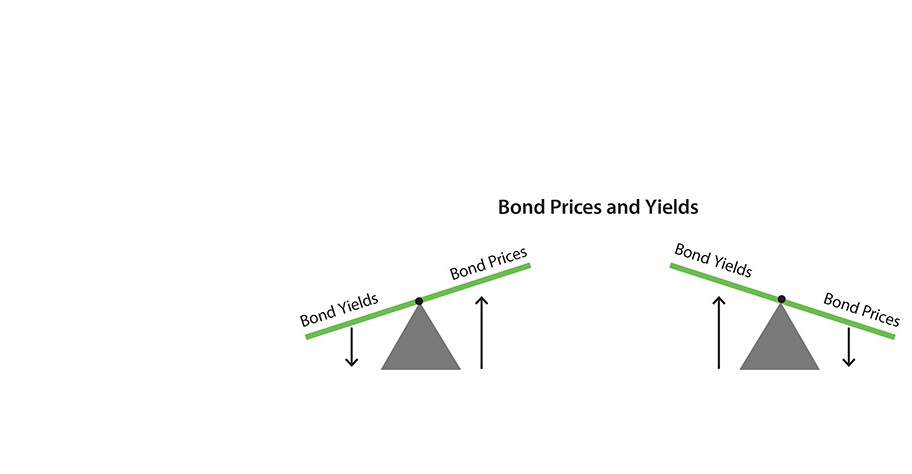
Why do bond yields go up, when bond prices go down? You might have come across a rule which states that When bond prices go down, bond yields go up & vice versa Let’s understand this rule. You will agree that when a seller of a goods sells at a lower cost, he makes a lower profit. However, the purchaser of the good makes a gain due to the attractive price of purchase. Now let’s understand with a simple example. Ravi has a corporate bond of Rs.100/- which gives him 10% returns per annum. In other words, the company would pay him Rs.110/- at the end of the year for the Rs.100/- loan that Ravi has given to the corporate. The 10% yield thus translates to a Rs.10/- profit for Ravi. Now let’s assume that Ravi has an emergency and needs money. He goes to his friend John who quickly realizes that Ravi needs money urgently. So, he makes and offer to Ravi to buy his bond for Rs.90/-. Ravi agrees to the offer and sells the bond for Rs.90/-. At the end of the year, John receives Rs.110/- from the corporate. Thus, John earns Rs.20/- from his investment of Rs.90/- in the corporate bond he bought from Ravi. Thus, John’s % return (which is popularly known as the yield)works out to: {20/90}x100 = 22.2% Thus, while Ravi was earning a return of 10%, the sale of the bond at a lower price of Rs.90/- translated into a gain for John in terms of higher yield which went up from 10% to 22.22%. Having understood the concept, it will not be difficult for you to appreciate the inverse relationship between the price of the bond and its yield (for the buyer of the bond). i.e., A bond’s yield goes up when its price goes down and conversely the yield of the bond comes down when the price of the bond goes up. When interest rates fall, it causes a fall in the value of the related investments. However, bonds that have been issued will not be affected in such a way. They will keep paying the same coupon rate as issued from the beginning, which will now be at a higher rate than the prevailing interest rate. This higher coupon rate makes these bonds attractive to investors willing to buy these bonds at a premium. Conversely, when interest rates rise, newer bonds will pay investors better interest rates than existing bonds. Here, the old bonds are less attractive and will drop their prices as compensation and sell at a discounted price.

Bond Price & Yield Read More »

LiquiLoans

LiquiLoans is a Profitable RBI Regulated Peer-to-Peer (P2P) NBFC founded in 2018. LiquiLoans is one of the only P2P platforms in India which provides investors an access to India’s Prime Retail Borrowers i.e., Safest Borrowers. LiquiLoans is founded by Mr. Gautam Adukia and Mr. Achal Mittal who have previously co-founded a successful rental platform Rentomojo (currently valued at over Rs. 950+ Crores). Together they have 25+ years of banking and start-up experience (Rentomojo, HSBC, ICICI, IIFL Wealth etc.) LiquiLoans is funded by Matrix Partners, which has invested in various marquee companies like Ola Cabs, Practo, Quikr and Cloud Nine. Other Marquee Angel Investors include CEO of CRED and Barclays Wealth Management. What is the role of LiquiLoans? LiquiLoans as a platform plays a critical role by assessing each investor to safely lend funds to only multiple creditworthy retail borrowers who pass the stringent credit assessment, thereby enabling investor to earn a high return by taking minimum / nil risk. Who are creditworthy retail borrowers? In India, all retail borrower’s get a credit score from (CIBIL) Credit Information Bureau (India) Limited, Experian Credit Score, CRIF Mark Credit Information (Top credit Rating Agencies for Individuals) basis their repayment performance which showcases their ability and intent to repay multiple credit lines / loans. These scores are in the range of 300 to 900 wherein prime borrowers i.e., borrowers having a high score (Average 700+) showcase that the borrower has been regularly repaying multiple credit lines/loans i.e., has demonstrated high ability & repayment intent. LiquiLoans sources such prime Borrowers, ensuring all investors on the platform get a diversified and safe exposure to such borrowers. How are high quality Borrowers Sourced? To source high quality prime retail borrowers LiquiLoans has tide up with, India’s largest service providers : 250+ Partners Services Offered: Up-skilling Education (Online MBA, Coding, Quant Trading, Data Science Courses, etc.) Discretionary Non-Fatal Healthcare (Hair & Skin Care, IVF and Stem Cell Procedures) and Home Decor (Upgradation of Self Owned Residential Property – Modular Kitchen etc.) Loans Offered: Largely No Cost EMI Loans Average Loan Value: Rs.50,000/- (Maximum up to Rs.10 Lakhs) Average Loan Tenure: Less than 12 Months (Maximum up to 36 Months) Revenue Model: Earnings via upfront discount (Subvention) offered by service providers for all approved customers. How are the borrowers evaluated? LiquiLoans sources only prime retail borrowers who are not credit hungry i.e., opt for a No Cost EMI Consumer Loan solely as a payment flexibility for their service being consumed from one of LiquiLoans’ Vendor Partners. Nearly 100+ data points are checked before approving the loan. How does LiquiLoans assist an investor to recover their money in case of a delay / default? All borrowers sourced by LiquiLoans mandatorily sign an auto-debit mandate before availing the No Cost EMI Loan, making it easy to collect EMIs on time. This ensures automated recovery on each due date as the borrower’s bank account is auto-debited and the EMI gets transferred directly to the Escrow bank account with IDBI Bank. To ensure minimal delay/defaults, LiquiLoans has multiple internal & external safeguards. Why is LiquiLoans safe? High Margin of safety: Investors have approximately 13% Plus safety margin i.e., unless the NPAs increase by approximately 13% the investor shall continue to earn back their full capital & indicate return. Currently the gross NPAs (Loan Defaults) are only around 0.64% (highest recorded was just 1.63% in peak covid in October 2020. Since inception, 100% of investors have made full return with LiquiLoans. Investments are spread across 200-300 plus prime retail borrowers. Exposure to single borrower is less than 0.50% High diversification amongst prime borrowers reduces concentration risk. LiquiLoans platform earns only after the investor. Investment plans Liquid Plan with 8% XIRR, Invest and withdraw any time, best corpus for emergencies, more interest than savings bank account. Short duration plans ranging from 3 Months, 6 Months, 12 Months , 12 Months, 24 Months & 36 Months, Interest ranges from 8.6% XIRR to 9.35% XIRR Flexi Lock-in Plans 12 Months, 24 Months & 36 Months where one gets benefit of earning higher returns with the option to withdraw any time. One can park money for use during unplanned expenses. Interest approximately 9% XIRR. There is option of smart SIP with minimum Rs.5,000/- Investment per month with 8% XIRR and one can withdraw anytime.  Interest Pay-out Plans Monthly Interest Pay-out Cumulative Interest Pay-out (Growth) How much can one invest? Minimum Investment amount is Rs.10,000/- and Maximum Investment amount is Rs.50,00,000/- Who can Invest? Individuals (18 years older or above), Hindu Undivided Family (HUF), Corporate (Incorporated under Indian Companies Act or RBI Listed Finance Companies), Partnership Firm, Limited Liability Partnership( LLP), Body of Individuals, Society, Artificial Body. Even an NRI can invest.

LiquiLoans Read More »