
Debt

Debt Spiral

A debt spiral is when one falls deeper and deeper into debt, despite staying current on payments. It can happen when there is high-interest debt, or if there is sudden need of more debt or one loses income. In a debt spiral, a person is so deep in debt, he needs to borrow even more to pay off their dues. But in doing so, his debt becomes bigger and tougher to repay, keeping him trapped in unending financial misery. Besides the stress, loan repayment problems remain on the credit record for years and could make it difficult to get fresh loans in a time of need. The spiral of debt often happens over time, rather than overnight, and breaking the cycle may take time as well. Debt repayment plan will help in ending the debt cycle, but it also means re-examining the behavior and attitudes about money that lead to debt in the first place. Example If the credit card is not used properly i.e., if you might start buying things you would not buy with cash because you feel that the credit card gives you the power to buy more items. You get the illusion that a credit card is your money, when in fact, it is borrowed money; money you do not owe. This is where you begin to fall into a debt spiral. And now, you will apply for another card, maybe two or three cards, and swear you will use them wisely. Unfortunately, you won\’t and the amount of your income that goes towards servicing your credit card debt will keep on growing and before you realize it, as if all in one day, your credit card debts have gone out of control. At the same time, you might have an auto loan, personal loan and a car loan too. So, the total burden of debt will begin to get too difficult to control, and you will start to use your credit card to repay them off. Sound like a great financial strategy? Wrong. Doing so only increases your portion of the more expensive credit card debt, in a futile attempt to show you are repaying your often cheaper debts, credit card debts are often the most expensive. Sooner than later, you will begin to pay off your card using another card, and at this point you will note that you are having money problems. It is like adding fuel to fire, the fastest way to get to the rock bottom. You do not need to live in a permanent debt spiral. Debts can be repaid. You can climb out of the spiral, but will first need to acknowledge the situation that you are in. If it is time to do something about your debt, here are ways to get out of the debt spiral. List all the debts you have Create an accurate budget Decrease your outgoings Increase your Income Reach out for help if required Put money into savings account Stop yourself form getting into any more debt Avoid impulse buying Prioritize your debt If you are careful with your budget, cut off your lines of credit and stay in control of your personal finance, you should see small changes over the course of a few months. You are unlikely, however, to see a big instant improvement. Stay optimistic. Subsequent debts will be paid off more quickly. You will not be struggling forever.


Debt Spiral Read More »

Modified Duration

Let’s say I am a stockiest of winter clothes. In anticipation of a severe winter, I have stocked clothes in excess. My biggest concern is whether I will be able to sell all these before the onset of summer. If summer steps in earlier than expected, then I will have to lower the price to clear the stock. But if winter gets more severe and prolonged, then I could charge a premium for the goods that I have in stock and since I have a large supply, I would make more money. Thus, the behavior of an external factor has a major impact on the prices I charge. In the light of this example, lets understand the concept of “modified duration”. Modified Duration by definition expresses the sensitivity of the price of a bond to a change in interest rate. The change in interest rate can be linked with the season change as explained in the previous example. If the modified duration of a debt fund is less, it is similar to having less stock so that even if the interest rates were to change, the impact on price would be less. On the other hand, if the modified duration is higher, it would be like having excess stock so that if interest rates were to change, the impact on prices would be large. So higher the modified duration, higher is the risk of price fluctuation and lower the price of a bond and the interest rate have an inverse relationship, i.e., if the interest rates rise, the price of the bond would fall and vice versa. The modified duration explains the extent of rise or fall in bond price, given a change in interest rate. Mathematically, change in price of a Bond is the arithmetic product of Modified Duration of the Bond and change in external interest rate. So, if a Fund Manager feels that the interest rates are going to rise (similar to expecting the summer setting in sooner than expected), he would reduce the modified duration of the portfolio. Alternatively, if he feels that the interest rates are to fall (similar to expecting the winter to last longer), he will maintain a higher duration and benefit from the fall in interest rates. Let us now use modified duration to calculate the change in price of a bond for a given change in interest rate. CHANGE IN BOND PRICE = (- MODIFIED DURATION) X (% CHANGE IN YIELD) The negative sign in this equation indicates inverse relationship between change in yield and change in bond price. For example, if the modified duration of a bond is 5 and yield is expected to fall by 2% in a year, expected change in price of the bond (on account of change in yield) can be calculated as CHANGE IN BOND PRICE = (- 5) X (-2%) = + 10%. Similarly, if the modified duration of a bond is 5 and yield is expected to rise by 2% in a year, expected change in price of the bond can be calculated as CHANGE IN BOND PRICE = (- 5) X (2%) = – 10%. Some key points about modified duration: A “Bond” with a lower “modified duration” implies that the “returns” are more from accrual income than from capital gains. A “Bond” with a higher “modified duration” implies that the “returns” are more from capital gains than from accrual income. Maturity remaining the same a high coupon yielding bond would have a lower duration and hence be less sensitive to changes in external interest rates as compared to a low coupon yielding bond. Modified Duration conveys the impact of change in interest rate on the change in the price of the security, therefore, it simply tries to calculate the percentage change in the price of the security that is caused by a percentage change in the interest rates of that security, and so, we can conclude that it is a slope variable or the first differential of the price with respect to interest rate.

Modified Duration Read More »

Open Market Operations

OPEN MARKET OPERATIONS Often, we come across the term called ‘OMO’. What is OMO? An Open Market Operation (OMO) is the buying and selling of government securities in the open market. It is done by the Reserve Bank of India. When there is excess liquidity in the market, the RBI intervenes and sucks it out by issuing bonds, among other means. At the same time, if the liquidity starts to dry up in the markets, the RBI intervenes and infuses liquidity by buying back the bonds that are with the investors. What is the outcome on account of OMO? When the RBI buys bonds from the market and infuses liquidity, the consequences are: It tends to soften interest rates. Fresh bonds can be issued at lower yields and the government can thus borrow at a reasonable cost. It enables corporates to borrow at favorable interest rates. It prevents the rupee from strengthening unnecessarily and thereby protects the interest of exporters. It may tend to increase inflation. If the RBI were to sell bonds instead and suck out the liquidity, the effect would be exactly the opposite. Thus, OMOs are an important instrument of credit control through which the Reserve Bank of India purchases and sells securities. Types of Open Market Operations RBI employs two kinds of OMOs: Outright Purchase (PEMO) – this is permanent and involves the outright selling or buying of government securities. Repurchase Agreement (REPO) – this is short-term and are subject to repurchase. To sum up: What : Open Market Operations (OMOs) are a means by which a central bank control’s the nation’s money supply by buying and selling government securities and / or other financial instruments. Why : It helps regulate interest rates and foreign exchange rates.

Open Market Operations Read More »

Debt Equity Ratio

Debt Equity Ratio In life we should be grateful to all those who have helped us in making us what we are. So, who are these people we need to be indebted to? They are our teachers, mentors, leaders etc. who light up the path that we tread upon. We owe them our success. And in return they earn “Guru Dakshina” in the form of their fees. So, while we gather knowledge from our teachers and progress in life by earning wealth and fame, all that they receive is their professional fees and goodwill from their students. Even if we are unable to make the most of our education and fail to make it big in life the amount of professional fees remains the same. Hence the “Guru Dakshina” remains fixed irrespective of the outcome. This “Guru Dakshina” is similar to the debt, companies take from banks. Whether the companies deploy the money profitably or not they are liable to repay their debts. And of course, companies should be grateful or indebted to the banks who help them to succeed by providing capital at the right time. While we remember our teachers, we must not forget the teachers who never demanded their “Guru Dakshina” from us. Who are they? They are our parents. They laid the foundation of our lives. They taught us our values and beliefs. And if we stand tall today it is because of the platform they gave us earlier in life. But they never took a fee or asked for their share of “Guru Dakshina”. Why did they do that? They did that because for them their “returns” were directly linked with our well-being. Their happiness, their success and their “Guru Dakshina” was to see us succeed. Since they never asked for professional fees, their contribution cannot be termed as debt. So, what is it? Their participation in our lives can be compared with “equity” participation of investors in companies. Investors who participate by way of equities take the risks and do not demand a fee. They allow the company to perform without worrying too much about timely returns. In that sense they allow more “elbow room” to the management. Whether the company succeeds or fails they are part of its destiny. However, they earn their returns if the company turns profitable. Similarly, parents think of their children’s success as their returns. Thus while “debt” is like paying professional fees to teachers, “equity” is like the sharing of one’s fame and success with parents. Hope the concept of “Debt” and “Equity” has been made clear for you. Now let us look at the Debt : Equity ratio. So as per our understanding we can now see this ratio from a different perspective. While debt has to be serviced on time, “returns” for equity investors can be paid out of net surplus. So, if Debt : Equity ratio is 2:1 it means the company has larger debt on its books. Companies which are capital intensive have high ratios. Another interpretation of a high ratio could be that the management’s confidence in the business is high. But investors should realize that a very high Debt : Equity ratio also means higher debt obligations and hence accompanied risks. If the Debt: Equity ratio is 1:1 it means that the company does not have much debt obligations on its books. Software companies which have limited capital investments usually have a lower Debt : Equity ratio. Sometimes a low Debt : Equity ratio could also mean that the company is not aggressive enough. However, what is most important is the fact that Debt : Equity ratio might be a necessary measure to judge the health of a company but is not a sufficient measure to come to any conclusion. One would have to study other parameters like Gross and Net Profit, ROCE, ROE, etc. before coming to any sort of conclusion about the health of the company.

Debt Equity Ratio Read More »

Significance of Yield in Bond Market

Significance of Yield in Bond Market Bond yield is the return an investor realizes on a bond. The bond yield can be defined in different ways. Setting the bond yield equal to its coupon rate is the simplest definition. The current yield is a function of the bond\’s price and its coupon or interest payment, which will be more accurate than the coupon yield if the price of the bond is different than its face value. When equity markets are bullish, we say “The Sensex has “gone up” or “Equity prices have “gone up” BUT When bond markets are bullish, we say “yields” have “gone down” Why?? When bond markets move up, we say that the “yields” have gone down whereas when bond markets fall, we say the “yields” have gone up. Thus, there seems to be an inverse relationship between the markets and the “yields” However, it is quite the opposite with Equity Markets where the “SENSEX” is said to go up with rising markets and go down with falling markets, Thus, there seems to be a direct relationship between the equity markets and the SENSEX. In equity markets a business offers its shares to investors who are willing to take a risk on the business succeeding and thereby making big gains. In a bond market the business raises debt capital where the investors invest money for a fixed period at a particular rate of interest. When the bond markets are bullish (positive) it means there are many investors who are willing to lend money. In such a situation the business can expect to raise capital at a lower interest rate or “lower yield” Hence, we say that “when bond markets are bullish the yields fall”. Let me explain with an example. Let’s say I issue a debt paper of ₹100 each at 10% interest p.a. This means that an investor who lends me ₹100 for one year will earn ₹10 at the end of the year. Thus, at the end of the year I will return ₹110 (₹100 + ₹10) In a bullish market there are several investors who want to invest and papers are in short supply. In such a situation, perhaps I would find an investor who is willing to pay ₹105 for my debt instrument for which I had paid ₹100 to the original issuer for earning a 10% interest. In this situation I become the issuer to the new investor who purchased the debt paper from me for ₹105. The earning of the new investor works out to be ₹110 – ₹105 = ₹5 And the amount of interest he earns works out to (Profit/Invested amount) x 100 = {5 / 105} % = 4.7% Thus, we see that when the market is bullish the yields come down and one is able to raise capital at lower interest rate.

Significance of Yield in Bond Market Read More »

Bond Laddering

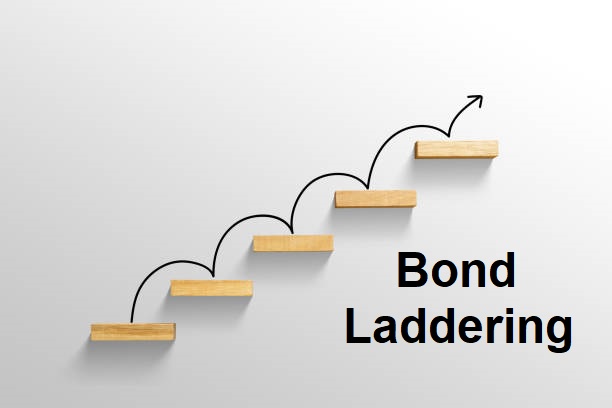
BOND LADDERING Bond investing is much like a game of musical chair in which bond prices move to the tune of interest rates. Sometimes you might feel that you have no control over what happens to your bond portfolio with the future movements in interest rates. But familiarity with ‘bond laddering’, an investment strategy, could help deal with what is called reinvestment risk. How Bond Laddering Works A bond investor might purchase both short-term and long-term bonds in order to disperse the risk along the interest rate curve. That is, if the short-term bonds mature at a time when interest rates are rising, the principal can be re-invested in higher-yield bonds. If interest rates have hit a low point, the investor will get a lower yield on the reinvestment. However, the investor still holds those long-term bonds that are earning a more favourable rate. Essentially, bond laddering is a strategy to reduce risk or increase the opportunity of making money on an upward swing in interest rates. In times of historically low interest rates, this strategy helps an investor avoid locking in a poor return for a long period of time. However, The face value of each bond might be same. For example, a bond portfolio of Rs10 lakh may have 10 different bonds of Rs1 lakh each maturing after one year, two years, three years and so on. In such a situation, your bond portfolio would actually look like a ladder in which every year some of your bonds would be maturing, generating a steady cash flow. This cash flow, if you so like, can be reinvested again to create another rung of a bond ladder. style=\”text-align: justify;\”This kind of strategy ensures that your entire bond portfolio does not mature on the same date. Rungs By taking the total amount you plan to invest and dividing it equally by the total number of years for which you wish to have a ladder, you will arrive at the number of bonds for this portfolio or the number of rungs on your ladder. The greater the number of rungs, the more diversified your portfolio will be and the better protected you will be from any one company defaulting on bond payments. Height of the Ladder The distance between the rungs is determined by the duration between the maturity of the respective bonds. This can range anywhere from every few months to a few years. Obviously, the longer you make your ladder, the higher the average return should be in your portfolio since bond yields generally increase with time. However, this higher return is offset by reinvestment risk and the lack of access to the funds. Making the distance between the rungs very small reduces the average return on the ladder, but you have better access to the money. Well, reinvestment risk of a bond is something that arises due to future movements in interest rates. Other Benefits of Bond Laddering Bond laddering offers steady income in the form of those regularly occurring interest payments on short-term bonds. It also helps lower risk, as the portfolio is diversified because of the various maturation rates of the bonds it contains. In effect, laddering also adds an element of liquidity to a bond portfolio. Bonds by their nature are not liquid investments. That is, they can\’t be cashed in at any time without penalty. By buying a series of bonds with different dates of maturity, the investor guarantees that some cash is available within a reasonably short time frame. Bond laddering rarely leads to outsized returns compared to a relevant index. Therefore, it is usually used by investors who value the safety of principal and income above portfolio growth. It is a lot like ‘not putting all your eggs in the same basket’. Likewise, your entire bond portfolio should not mature on the same date. To Sum Up What: Bond laddering is an investment strategy that tries to minimize the risk associated with the future movement in interest rates. How: A bond portfolio using laddering would consist of bonds having same face value maturing on different dates at a regular interval. Why: Bond laddering strategy is useful because it helps in minimizing the reinvestment risk.

Bond Laddering Read More »

Credit Spread

CREDIT SPREADS A credit spread refers to the difference in interest rates between a corporate bond and a comparable Government bond. Assume that the interest rate on a five-year corporate bond is 6 per cent and that on a similar five-year Government bond is 5 per cent. This means that the interest on a corporate bond consists of a risk-free rate of 5 per cent plus a credit spread of 1 per cent. Different securities in the market have different risk profiles. Therefore, compensation is paid to investors proportionately according to the risk taken by the investor in selecting a particular security. There will be a spread between two different kinds of papers due to the following reason: Credit quality – Lending money to the Govt. is any day safer than lending money to a corporate because the Govt. will never default. Hence, one is willing to park one’s money at a lower yield. The difference in yields between two different kinds of debt papers in the market is known as credit spread. For example, if the Govt. security is giving an yield of 4% while a corporate paper is giving an yield of 7%, the difference between them is 3% – which is the credit spread. However, the spread between a Govt. and good quality corporate papers is usually around 1.5%.

Credit Spread Read More »

Zero Coupon Bond

WHAT IS COUPON…? The term \”coupon\” is derived from the historical use of actual coupons for periodic interest payment collections. The coupon rate is the interest rate paid on a bond by its issuer for the term of the security. ZERO COUPON BOND Zero coupon bonds is a bond that is issued at a discounted price and redeemed at par at the time of maturity. Example Rahul has invested Rs. 920/- in a zero coupon.    Assume that  after  1 year  he  would  receive Rs. 1000/- . In the   instant  case Rahul pays  920/-  (Discounted price)  and  he would receive   Rs. 1000/- (Par value) after 1 year. Return (yield)   on   the   bond for Rahul is  70%  and  can be  arrived  as  follows  (1000 – 920) / 920. Thus Zero Coupon Bond is nothing but  a  terminology used for a bond that is issued at  a  discounted  price  and redeemed at par on maturity.

Zero Coupon Bond Read More »

Debt

What Is Debt…? Debt is an amount of money borrowed by one party from another. Debt is used by many corporations and individuals as a method of making large purchases that they could not afford under normal circumstances. A debt arrangement gives the borrowing party permission to borrow money under the condition that it is to be paid back at a later date, usually with interest. Risks in Debt Credit Risk Default Risk Interest Rate Risk Credit Risk Credit risk is better termed “Credit RATING RISK” which is the risk that a bond gets its credit rating changed. If bond ratings changes from AAA to A, it means there is a large increase in risk, usually due to a worsening financial or political situation. Let us take an example of a company TCS TCS issues a bond for ₹100/- per bond at 9% interest. Suppose the credit ratings of TCS Bond is AA. If credit rating improves from AA to AAA the bond can trade at ₹105/- instead of ₹100/-. If the credit rating impared from AA to A then the bond can trade at ₹95/- instead of ₹100/-. Now, this is called credit risk. Default Risk Default risk is the risk that a borrower fails to make Principle or interest payments when they are due. Default risk affects the interest rate charged on a debt instrument. The greater the default risk, the higher the interest rate charged by lenders. Interest Rate Risk The risk of value depreciation of bonds and other fixed-income investments is known as interest rate risk. Primarily due to depreciation in their interest rates, this happens because of market fluctuations. Such risk affects many types of investments, though it primarily affects fixed-income investments. Effects of Interest Rates on Bond Prices and Debt Fund Net Asset Value (NAV) Interest Rates        ↑                  Bond Value        ↓                  Debt Fund NAV        ↓   Interest Rates        ↓                  Bond Value        ↑                  Debt Fund NAV        ↑   Let us take an example of the Company TCS TCS issues a 5 year bond for ₹100/- per bond at 9% interest. If the interest rate comes down to 8% the price of the bond can rise to ₹105/- and if the interest rate rise to 10% the price of the bond can depreciate to ₹95/-. Types of Debt:- Money Market Long Term Fixed Income Invests for less than one Year Invests for More than one year Treasury Bill (TBill’s) Commercial Papers (CP’s) Certificate of Deposits (CD’s) Bonds ·         Government of India & State Development Loans (SDL’s) ·         Corporate Securities Collaterized Borrowing and Lending Obligation (CBLO), Triparty Repo (TREP’s) Non-Convertible Debentures (NCD’s), Pass Through Certificates (PTC’s) Do you know? Why Debt have different names like TBill’s, CP’s, CD’s, CBLO, Gsec, SDL’s, NCD’s, PTC’s? Because the tenure of the product is different and Borrowers are different.   Borrowers Money Market Long Term Fixed Income Tenure Invests for less than one Year Invests for More than one year Central Government Treasury Bill (TBill’s) Government Securities (Gsec), State Development Loans (SDL’s) Banks Certificate of Deposits (CD’s) Fixed Deposits Corporates Commercial Papers (CP’s) NCD’s, Debentures, Corporate Securities Is there any risk associated with the Money Market and Long-Term Fixed Income instruments? Product Borrowers Can Default or not Treasury Bill (TBill’s) Central Government No Commercial Papers (CP’s) Corporates Yes Certificate of Deposits (CD’s) Banks No CBLO / TREPS Banks No NCD’s, Debentures, Corporate Securities Corporates Yes Gsec, SDL’s Central / State Government No Since Guaranteed by RBI  Collateralized Borrowing and Lending Obligation (CBLO) CBLO is a money market instrument that represents an obligation between a borrower and a lender concerning the terms and conditions of a loan. These instruments are operated by the Clearing Corporation of India Ltd. (CCIL) and Reserve Bank of India (RBI), with CCIL members being institutions with little to no access to the interbank call money market in India. The instrument works like a bond where the lender buys the CBLO and a borrower sells the money market instrument with interest. CBLOs allow those restricted from using the interbank call money market in India to participate in the short-term money markets. State Development Loans (SDL) State Development Loans (SDL) are debt issued by state governments to fund their fiscal deficit. SDL issues are managed by the RBI, which also makes sure that the SDL\’s are serviced by monitoring escrow accounts for payment of interest and principal. The SDL market is similar to that of the government bond market. SDL\’s are traded electronically on the NDS-OM (Negotiated Dealing System-Order Matching) and traded in the voice market (NDS). Triparty Repo (TREPs) Transactions in the overnight triparty Repo Dealing and Settlement (TREPs) are being done by banks, mutual funds, NBFCs and others with government securities as collateral. These transactions can be done for various duration ranging from overnight to as long as 365 days. Pass Through Certificate (PTC) Pass Through Certificates are high quality debt instruments that represents ownership in a pool of assets and derive monthly principle and interest payments from those assets. PTC’s are nothing but securitization i.e. transforms illiquid assets in to liquid assets. Modified Duration Modified duration is a formula that expresses the measurable change in the value of a security in response to a change in interest rates. Modified duration follows the concept that interest rates and bond prices move in opposite directions. Let us take an example where interest decreases, what will be the effect on the Fund. Interest Rate Decreases by Fund A Modified Duration 5 Years Fund B Modified Duration 2 Years 1% 1% * 5 Years = 5% Yield to Maturity + 5% 1% * 2 Years = 2% Yield to Maturity + 2% 0.5% 0.5% * 5 Years = 2.5% Yield to Maturity + 2.5% 0.5% * 2 Years = 1% Yield to Maturity + 1% When Interest rates falls invest in medium duration or long duration debt funds. Let us take another example where interest increases, what will be the effect on the Fund. Interest Rate Increases by Fund A Modified Duration

Debt Read More »

Duration Management

Duration Management Debt funds invest in debt papers which need to give good fixed returns & be of good quality. Based on the interest rate outlook, the fund manager decides whether to invest in long duration papers or short duration papers.   But how is his decision of selecting long duration papers or short duration papers connected with the interest rate outlook..?   Simply speaking, when interest rates are expected to go up, the debt fund manager would invest in shorter duration papers but if interest rates are expected to come down, then he would do the opposite and invest in longer duration papers.   When a fund manager thinks that interest rates are likely to go up in the near future, it means that debt papers in the future will offer better rates of return. Even he observes that as the interest rates are likely to rise soon and debt papers gives a higher interest rates which would become available, he invests in papers with shorter maturities, so that by the time the interest rates rise, his papers have matured and he has cash to invest in the new papers.   Now what happens when the debt fund manager believes that interest rate is more likely to come down…? He just reverses his strategy and invests in long duration papers. so, his money stays invested in higher interest bearing papers even in a lower interest rate regime. The value of the higher interest bearing papers too would go up and the fund manager too could extract a higher price by selling it in the market…!

Duration Management Read More »