Rajen Gala

External Commercial Borrowings

Let’s assume you suddenly have a guest at home and you are running short of milk to prepare tea. In such a scenario you will have no option but to borrow some from your neighbors, which you can replace later. Likewise, external means non-Indian / foreign source, commercial would mean engaged in commerce and borrowing means acquire temporarily with a promise to return along with interest. The concept of this strange sounding term is just as simple. ECB has become a major source  for raising money by large Indian companies in recent years. In comparison with India, interest rates are a lot lower abroad. Therefore, this is the single biggest incentive for companies raising money from overseas. For example, even if a company borrows in the international market at 4% for one year; the cost of borrowing for a similar tenor may be close to 10% in the domestic market. Companies in India are allowed to borrow from overseas, under certain conditions, through different instruments, with a minimum average maturity of 3 years. The main objective is to provide companies with an option of low-cost capital. However, it is not that ECB is always beneficial to a company and the country and does not carry any risk. There is a definite risk involved. The depreciation of the rupee is the biggest hurdle to this kind of borrowing. Let’s assume, I have borrowed $100 at 4% and converted it into rupees at Rs.85/- per dollar. Now effectively I have borrowed Rs.8,500/- at 4%. Under normal circumstances, I will have to pay $104 after a year. So, if the currency were to remain stable, I would have added the interest amount (4% of Rs.8,500/- which is Rs.340/-) to the principal to make it Rs. 8,840 and buy US dollars at the rate of Rs.85/- per dollar.  This would fetch me Rs. 8,840/-/Rs.85/- = $104. So far this makes complete business sense. Isn’t it? But what if the rupee depreciates to Rs.100/-? As far as the overseas party is concerned the liability of the Indian company is clearly $104. At $1 = Rs.100/-, Rs.8,840/- would only fetch me Rs.8,840/-/ Rs.100/- = $88.40. There is thus a shortfall of $15.60 ($104 – $88.40). Now, the cost of buying additional $15.60 at Rs.100 per dollar turns out to ($15.60 x Rs.100) = Rs.1,560/-. Thus, the interest which was planned as Rs.340 turns out to be (Rs.340/- + Rs.1,560/-) Rs.1,900/-. Now if you were to calculate the rate of interest the business enterprise in India lands up paying turns out to be (Rs. 1,560 / Rs.8,500) x 100% which works out as 18.35% which is much more than the 10% interest rates prevailing in the local market. Thus, in this case the borrower would surely feel short changed. The opposite will be the scenario incase rupee appreciates against the dollar.

External Commercial Borrowings Read More »

Investments helps the Economy

Most of us work for a living. But what do we do to the income that we earn? Many of us simply keep the money in the form of cash. Did you know that just by keeping money as cash at home we are not helping our economy? Sounds confusing? Let us say there is a community of people living in a particular area. Let us also assume that these people have their houses around a huge piece of barren land. So, in a sense their houses run around the periphery of the barren land. Now Most of these people love their homes. They all have flowerpots in their homes which they water without fail. They also love to keep their floors clean and wash them daily. But They never bother to walk out of their homes and water the barren land nearby. So, the field continues to be barren and of no use to anyone. Then one day a wise man comes to town. The people of the town look to him for solutions to their day-to-day problems. He tells them “Just water the barren land daily.” Most people are amused by this strange recommendation. How would watering the barren land help them. Nevertheless, from the very next day the people make it a point to water the barren land. They do this daily. Slowly as time goes by, the people see plants grow on the barren land. Over time these plants grow and become trees. They bear fruits and vegetables in exceptionally large quantities. The people not only consume the fruits and vegetables but also sell the produce in the market and earn from it. The wise man revisits them. He finds out that all the residents are extremely happy. They tell him that not only are they enjoying the fruits from the garden but are also earning from the same. The wise man tells them that the field at the center of their houses was like the economy of the country and the water that was provided was like the money in our pockets. Just as the regular watering of the barren land converted it into a garden full of fruits and vegetables in the same manner regular investments in the economy provides the money needed by the economy for creating wealth. Thus, the wise man successfully convinces the residents that they should not save money as cash or near cash but instead invest the same in stocks, mutual funds, bonds etc. for the sake of creating wealth for themselves as well as the nation.

Investments helps the Economy Read More »

Imported Inflation

We have often heard our parents or grandparents saying that they used to manage the entire house for one hundred rupees a month in “those days.” We usually smirk and say “Gone are those days. Today we cannot even have one full meal in one hundred rupees.” Blame it on inflation. Inflation erodes the purchasing power of money such that Rs.100/- today is no longer Rs.100/- tomorrow. We understand inflation, but what does imported inflation mean? When the general price level rises in a country because of the rise in prices of imported commodities, inflation is termed as imported. No country in the world is self-sufficient by itself. Each country depends on other countries for goods and services which are not produced domestically. For Instance, India imports about three quarters of its total crude oil consumption. Therefore, if oil prices go up in the international market, inflation in India will also go up due to higher prices of the petroleum products. However, it is not necessary that only rise in the price of a traded commodity in the international market fuels imported inflation. Inflation may also rise because of depreciation of the domestic currency. For example, if the rupee depreciates by 15% against the US dollar in a particular period, the landed rupee cost of oil will also go up by a similar proportion and will affect the price and inflation numbers. Let us consider an example. Suppose we import Petrol at $100 a unit. And the exchange rate is Rs.85/- per dollar. This means we need Rs.8,500/- to first buy $100, and then pay for the Petrol purchase of one unit. Therefore, the price of Petrol depends on two factors: Price of Petrol (in dollar terms) Price of the dollar As explained above, price of petrol in India is directly proportional to the price of petrol in dollars, but also is impacted by the price of the dollar. Let us understand how. Suppose the price of the dollar goes up to Rs.100/- per dollar. This means that we will have to cough up Rs.10,000/- to buy $100 for the purchase of one unit of Petrol. So, even though the price of Petrol continues to be stable in the international market at $100, the price of Petrol in India goes up from Rs.8,500/- per unit to Rs.10,000/- per unit. So, while there is 0% increase in the price of petrol in the international market, the price of petrol in India increases by approx. 11.76%. Therefore, one often reads that the devaluation of the rupee will bring in imported inflation.

Imported Inflation Read More »

Government Debt Repayment

These days, the world over, governments are borrowing more and more money from the market. You may have wondered how governments always manage to create a mountain of debt for themselves. But ever wondered how governments ultimately repay their debts? There are several ways by which a government actually repays its debts. Well, borrowing money is obviously not a problem for any government. After all, a government’s promise to repay does not require any collateral. But we need to understand a little bit about how governments manage their finances first before moving on to the repayment of their debts. To start with… Just like individuals, a government has to constantly balance income and expenditure. Governments have only limited sources of income, which look like peanuts when we look at the mountain of expenditure. So, before planning anything, the government does need to find some extra money. But where is this extra money going to come from? Now… Although default by a government is not common, we can’t say that it is completely improbable. Sometimes governments too default in the repayment of their debts. But you would hear about a government defaulting only in extreme situations. By & large, the track record of governments repaying debts appears as clean as a whistle. There are several ways by which a government actually repays its debts… First and foremost… For actually repaying its debt, a government needs to develop a fiscal surplus that can be used to buy back existing government securities. A fiscal surplus can arise only if the government’s income exceeds its expenditure. To make that happen, a government would need to improve its income and reduce its expenses. Unfortunately, there is no fixed formula of how to reduce expenses, but when it comes to improving income, all governments have to use their famous weapon: taxes. Here’s how… But taxes in themselves may not be enough to repay all debts. Taxes are very helpful in meeting the yearly payments of interest, but to actually retire the mountain of debts, the government may need to think of other strategies. What other strategies can the government follow? The government can use public sector companies to its advantage. This can be done in two ways. First option: The government can choose to keep the public sector companies with itself and use their yearly dividends to repay debts. This will produce slow but steady results. Every year, a part of the debt would get repaid, provided the government is not planning to use dividends for any other purpose. Otherwise… Second option: The government can choose to divest its holding in public sector companies at the best available opportunity and use the proceeds for repayment of debts. Disinvestment produces immediate results. A mountain of money received from disinvestment can be used to retire a mountain of debt in one shot. Most governments around the world that are now putting their money to bail out private enterprises expect to repay their debt by profitably divesting their holdings when the right time comes. But what if nothing works? When nothing works, governments can resort to their least popular choice: Borrow money to repay existing debt. But that’s not all. When borrowing becomes difficult, governments may even resort to printing notes. Such a course of action may lead to hyperinflation, which indicates that the government has gone bankrupt. So even if you get your money back, it is a worthless piece of paper. Luckily, we have many sensible central banks to prevent things from coming to such a pass. To Sum Up What: Governments repay their debts in several ways. When: To actually repay its debt, a government needs to develop a fiscal surplus, but sometimes that may not be possible. How: Taxes, Public Sector Companies & borrowing programmes may be used. In the worst case, a government may resort to printing more notes to repay existing debt.

Government Debt Repayment Read More »

Devaluation

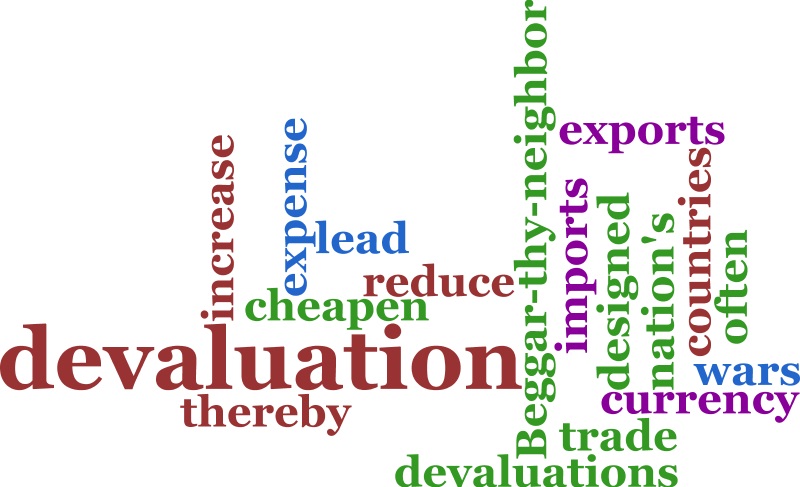
Understanding the Relationship between Devaluation, Beggar Thy Neighbor and Currency War. Let’s say an American wants to buy Indian products. Indian products can only be bought by paying in Indian rupees. This means that the American cannot buy the Indian product unless and until he buys Indian rupees. Therefore, if the Indian government reduces the value of the rupee, the American can get more Indian rupees for every US dollar. Let’s say earlier he would get Rs. 70 for every US dollar but after devaluation he gets Rs. 80 for every US dollar. This means that after devaluation the American for 1$ can now buy a product for Rs. 70 and another for Rs. 10 whereas before the devaluation he was in a position to only buy one product of Rs. 70. So clearly the buying capacity of a US dollar increases because of rupee devaluation. Thus, for the American the product which was costing $1 previously would now be available to him at less than $1. To understand how many dollars it would now cost him, let’s look at the following: If Rs. 80 = $1 Then Rs. 70 = $? The above equation means that Rs. 1 is 1/80th part of a dollar in value. Hence Rs. 50 would be $(70 x 1/80) And this works to $ 7/8 = $.87 From the previous explanation one thing that gets clear is the fact that whenever a country devalues its currency, its exports get cheaper and attractive. And when this happens, there is a possibility that America (as in this case where our example talks about America and India) would prefer buying products from India than let’s say its neighbors (who have not devalued their currency). This policy of devaluing currency is also known as “Beggar Thy Neighbor” because it has the potential of harming the economy of neighboring countries by making their exports less attractive and causing a reduction in their exports. This in a sense sets up a sort of war between two countries for a higher export market share. This war is known as “Currency War”.

Devaluation Read More »

Fiscal Consolidation

Let me tell you a story of 2 brothers Karan and Arjun both of whom were educated and did well in their jobs respectively. However, two years back Karan lost his job. Suddenly, his world changed. He had to start making compromises in his day-to-day life. He was also considering discontinuing the education of his children. But fortunately, Arjun came to his rescue. He agreed to share his salary so that Karan’s life did not get disrupted. Therefore, Arjun had to postpone many of his plans such as purchasing a car for his family. For the next 6 months Karan got financial support from Arjun and managed to keep his problems at bay. However, after 6 difficult months Karan finally got a job and his cash flow situation improved significantly. Hence, his need for assistance also reduced. Hence, Arjun decided to discontinue the financial support to Karan. Having discontinued this financial support Arjun was in a good position to fulfill his plans of purchasing the car for this family. The financial support that Arjun provided Karan was like the fiscal stimulus that governments /central banks provided to industry during the financial crisis whereas his decision to discontinue the support once Karan’s position improved is nothing but the financial consolidation of Karan’s account. So, when we talk of financial consolidation what is meant is that because the Indian economy is back on track, a time has come to withdraw the fiscal support that was provided during the Covid-19 meltdown in 2020 so that the money could be put to better use from the economy.

Fiscal Consolidation Read More »

Capital Account Convertibility

The RBI has defined Capital Account Convertibility (CAC) as the freedom to convert local financial assets into foreign financial assets and vice versa at market determined rates of exchange without any sort of intermediation and regulation. So, what is its use? It is intended for local merchants to easily conduct trans-national business freely without any regulation or control. In case a currency is fully capital account convertible, then anybody from anywhere in the world can invest in any asset in that currency. Thus, a US citizen could buy a flat in India, allow it to appreciate and sell the same and take his contribution as well as the profits out of India to the US freely. Since this is not allowed in India and the government has its own rules and policies to regulate foreign investments, we say that India does not have full CAC. However, a word of warning… CAC also allows the people and companies not only to convert one currency to another, but also free cross-border movement of those currencies, without the interventions of the law of the country concerned. Thus, Indians could convert their rupees into dollars and park it in the US if there was capital account convertibility here. Imagine if a large number of Indians were to do this out of an irrational fear that India might go to war with Pakistan! What would happen then? This would lead to an irrational demand for dollar and would cause a free fall in the value of the Indian Rupee, thereby detrimentally affecting the economy. Something like this happened in the Asian crisis in Thailand where the citizens lost confidence in the Thai Baht leading to a mass sale of the currency and subsequent collapse of the same. This happened because their currency was fully capital account convertible. So, when can India expect to have full Capital Account Convertibility? For full CAC, the economy should be extremely stable so that its citizens are never made to feel insecure about their economy and drive them into irrationally converting their currencies and investing them abroad. Under the Tarapore Committee recommendations, this was possible only when the following conditions were satisfied: The average rate of inflation should vary between 3% to 5% during the debt-servicing time. Decreasing the gross fiscal deficit to the GDP ratio by 3.5% in 1999-2000. Convertible Account Convertibility in India is regulated as follows… All types of liquid capital assets must be able to be feely exchanged, between any two nations, with standardized exchange rates. The amounts must be a significant amount (in excess of $500,000). Capital inflows should be invested in semi-liquid assets, to prevent churning and excessive outflow. Institutional investors should not use CAC to manipulate fiscal policy or exchange rates. Excessive inflows and outflows should be buffered by national banks to provide collateral. In India… According to the RBI, as the Indian rupee is not fully convertible, it is not possible to go in for dual listing of shares which allows people to buy shares in the stock exchanges of one country and sell in the bourses of another country. Why? Because under dual listing, an African citizen could buy the stock in Africa and sell it in India, collect the rupees, convert it into ‘Rand’ and take them into the African economy – all this without any controls, permissions and regulations. This unhindered capital flow is not currently favored by the Indian Govt. To Sum Up What: Capital Account Convertibility is concerned about the ownership changes in domestic or foreign financial assets and liabilities. Why: This is so that local merchants can easily conduct trans-national business without falling short of foreign currency exchanges to handle small transactions. How: It allows people and companies not only to convert one currency to the other, but also free cross-border movement of those currencies, without the interventions of the law of the country concerned.

Capital Account Convertibility Read More »

Current Account Deficit

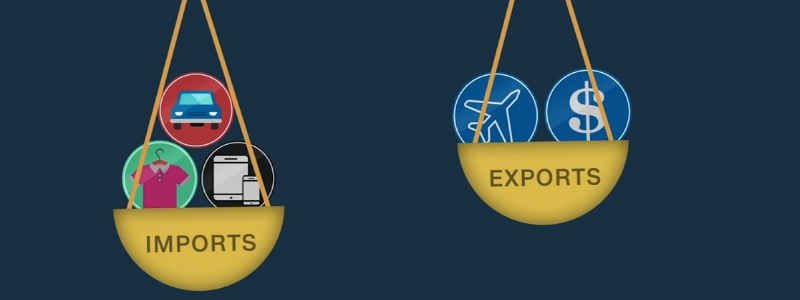
Suraj and Vipin travel together to work by train every day. As a usual morning practice, Vipin was reading a business paper when he came across the term \’Current Account Deficit\’. He wondered what it meant and asked Suraj to explain. Suraj tells him that if he answers a few questions, the meaning of the term Current Account Deficit will get clear. Suraj asks Vipin to name the sources of his income. Vipin identifies sources of income as Salary, Interest income from Fixed Deposits and Dividends from Mutual Funds. On hearing this, Suraj says, “Ok. But how about festival grants and birthday gifts received in cash?” Vipin agrees “Yes, sometimes”. Suraj then asks Vipin to list his expenses? On hearing this Vipin promptly responds, “Monthly house expenses, Children\’s school fees, Birthdays & Anniversary, occasional shopping and medical expenses.” Suraj then explains, “Now assume your expenses exceed your income this month. Then what will you do?” Vipin after a pause says, “Oh… then I will have to borrow money from someone.” Suraj continues to say, “Exactly. When your expenses exceed income, it is known as \’Deficit\’. And then you become indebted to the lender who lends you money.” “Ok. That is easy to understand.” says Vipin. Suraj continues explaining, “Similarly, Current Account for a country is expressed as the difference between the value of EXPORT of goods and services and the value of IMPORT of goods and services. In this context exports are “earnings” while imports are like “expenses”. A deficit then means that the “expenses” of the country are more than the income. In other words, the country is importing more goods and services than it is exporting. Current account also includes net income (such as interest and dividends from Capital Inflows or Outflows) and transfers from abroad (such as Workers\’ Remittances, Foreign Donations, Aids & Grants and Official Assistance), which are usually a small fraction of the total. A deficit implies that India is a net debtor to the world. The formula of the Current Account Balance (CAB) CAB = X – M + NI + NCT X          =          Exports of goods and services M         =          Imports of goods and services NI        =          Net income abroad    [Salaries paid or received, credit / debit of income from FII & FDI etc.] NCT     =          Net current transfers [Workers\’ Remittances(unilateral), Donations,Aids & Grants, Official Assistance and Pensions etc.]

Current Account Deficit Read More »

Fiscal Stimulus

Recession is the best time for some people to go on a vacation. They assume that by the time they come back, things will be back to normal. But for the saviors of the world economy, recession is the time to work overtime. They test various methods to get the economy back on its feet. One of the methods used is that of providing a fiscal stimulus package. Fiscal stimulus package? How can it stop recession? Well, you may have heard the name of John Maynard Keynes, the well-known British economist of the 20th century. The whole idea of fiscal stimulus is based on his analysis of factors that cause recession. During the Great US Depression of the 1930s, he wrote his most important work, The General Theory of Employment, Interest, and Money. What was it all about? Keynes focused his analysis on factors affecting output and growth in an economy. He asked, what decides the output in an economy? He said that output in any economy is decided by people who spend money. People like you and me who earn money with one hand and spend it with the other ultimately decide how much goods and services are going to be produced in our economy. If the demand of a product is less, then by the simple logic of demand and supply, the price of that product should fall. But it is difficult for firms to vary the price of their products frequently. For example, your baker may have to change the price of his bread every day if he goes strictly by demand and supply. Changing the price of goods every day is not a very happy way of doing business. Neither the baker nor his customers would be happy if prices just kept on changing forever. What options, then, does the baker have? He can let the price of the bread remain the same and reduce his production in response to lower demand. He can then meet the demand at the preset price by matching his supply with the demand. This is how demand affects output and growth in an economy. How can we use this understanding to fight recession? As per Keynesian analysis, the problem of recession is not due to lack of productive capacity in the economy. The factories have not lost their ability to produce goods, the real problem is due to insufficient spending to support the normal level of production. So, the solution is obvious. If the fall in demand leads to a fall in production, then we need to do something that can push up demand. What can one do about that? We have two options. The first option, as recommended by Keynes, is to increase Government spending, which works as the most effective way of increasing the aggregate demand of goods and services. The second option is to increase the disposable income in the hands of people by cutting taxes. Put money in the hands of people and even the most pessimistic person starts making new plans. It is believed that people will use part of their extra income on consuming extra goods and services. This creates what is known as a multiplier effect. You buy the bread of the baker, your baker in turn buys milk, and the milkman buys something else — in this manner, the game of passing the penny keeps going. Fiscal stimulus works as an instant source of energy. However, the timing of a fiscal stimulus and its size is most crucial for its success. To Sum Up What: Fiscal stimulus can be used as a tool for fighting recession. How: Increase in government spending coupled with tax cuts can lead to increase in aggregate demand and growth in the economy. Who: John Maynard Keynes, the well-known British economist, was a prominent advocate of the use of fiscal stimulus.

Fiscal Stimulus Read More »

Why should I pay Tax?

You always have a thought “Why should I pay Income Tax?”, whenever you see your salary slip you think that taxes eat up considerable portion of your salary, and you believe that taxes are nothing but a burden. But is it truly the case? Let us have a look at the importance of Income Tax in India. Income tax, GST, Customs Duty, Excise Duty, Road Tax, Property Tax, etc. are some of the most common taxes paid in India. There are numerous advantages to paying taxes. They aid in the creation and maintenance of infrastructure, such as roads, and they can even assist in the establishment or maintenance of institutions necessary for the rule of law and the operation of the democratic process. Tax money are used as follows, Taxes fund education. For example, in India, where illiteracy is a major problem, the government needs a lot of money to provide quality education; not only in urban areas but up to the grass root levels, including spending on school infrastructure, teacher’s salaries, research, development and innovation. Taxes fund public infrastructure and services. For example, in India, the country spends the highest proportion of its GDP on public infrastructure and services, as compared to other emerging economies. Taxes secure the country\’s borders. This includes expenditures on equipment and personnel, defense research and development, defense imports, international military cooperation, and international peace-keeping operations. Taxes fund the government\’s public transport system, including rail and road transport. This includes the purchase of a wide variety of vehicles, including airplanes, ships, buses, trains, coaches, tractors, tractors and other vehicles for road and highway construction, and other infrastructure projects. Taxes are also used for social development and welfare programs. For example, the government of India allocates a substantial amount of revenue, about 6% of GDP, for various social development and welfare programs, including public health and nutrition, education, and rural development programs. Taxes fund salaries and pensions of government employees. This includes wages and pensions of public sector employees such as central government employees, state government employees, and local government employees. Taxes pay the principal and interest on government debt. The government of India has a large external debt, and a sizable portion of its outstanding debt is denominated in foreign currency. And during these Corona times, the nation realized the need for great improvement in the Health & Medicare sector in our country. Subsequently Taxes fund the government\’s law-enforcement agencies, including the police, the paramilitary forces, the air and sea, border patrol, customs and excise, and intelligence agencies. This includes expenditures on personnel, equipment, training, and infrastructure to provide for security and public safety. Healthcare & Medical Infrastructure is also funded through taxes. This includes expenditures on health and medical research and development, hospital infrastructure, health insurance, and other health services. Taxes fund basic economic stability and social security schemes that are meant to help people who are unemployed or have a low income, such as the National Rural Employment Guarantee Act (NREGA) and the Mahatma Gandhi National Rural Employment Guarantee Scheme (MGNREGS). Taxes are mandatory contributions levied on individuals or corporations by a government entity, whether local, regional, or national.

Why should I pay Tax? Read More »