
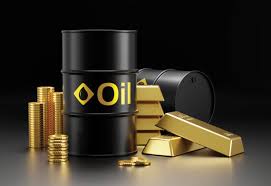
The gold-to-oil ratio measures how many barrels of crude oil you can buy with one troy ounce of gold. It’s calculated as:
Gold price per ounce ÷ Oil price per barrel
So, if gold trades at $4,800/oz and oil is $60/bbl, the ratio is 80:1 — meaning one ounce of gold buys 80 barrels of oil. According to recent data this ratio remains very elevated, near levels above 70–75 barrels per ounce in early 2026 — an unusually high reading compared to long-term norms.
Why It Matters
This ratio is not just a number — it reflects market psychology:
- High ratios typically mean gold is expensive relative to oil, often seen during uncertainty and flight to safety.
- Low ratios suggest oil is expensive relative to gold, often during strong economic activity and energy demand.
Gold tends to be a monetary hedge and store of value in uncertain times, while oil is a real economic commodity tied to industrial activity and growth.
Historical Context: What Has Happened Before
Over the decades, this ratio has swung widely:
Long-Term Averages
Historically the ratio has tended to average roughly 15–20 barrels per ounce over many decades.
Stable Growth Eras
1950s–1960s
Around 11–13 as stable economic growth and energy use pushed oil prices and gold prices in line.
1970s–1980s
Oil shocks from embargoes and geopolitical tensions pushed oil prices higher relative to gold, lifting the ratio into the 20s.
Early 2000s
Strong demand for oil kept the ratio low, sometimes below 10, signaling oil was relatively expensive.
Global Financial Crisis (2008)
Gold surged as a safe haven while oil saw volatility, keeping ratios elevated.
COVID-19 Pandemic (2020)
The ratio exploded to above 90 — a historic extreme — as oil demand collapsed, prices briefly turned negative, and gold soared.
Recent Decade
Post-pandemic recovery kept ratios above historical averages, with readings climbing into the 30s and higher as gold remained strong and oil lagged.
Where It Stands Now — Early 2026
As of now, the gold-to-oil ratio remains well above long-term norms, with many estimates placing it in the 70–80+ barrels per ounce range.
This is a highly elevated reading, historically associated with:
- Macro uncertainty
- Continued strong buying of gold as a safe haven
- Relatively weak oil pricing dynamics
- Dislocation between financial markets and real economic demand
Major analysis also notes that recent extremes signal an imbalance that has historically preceded periods of rebalancing between these commodities.
What Such High Levels Have Historically Signalled
Economic Uncertainty
Higher ratios often coincide with periods when investors seek safety, not growth — gold is bid up, while oil — tied to industrial demand — softens. Past examples include financial crises, pandemics, and major geopolitical stress.
Oil Appears Cheap Relative to Gold
Financial analysts interpret current high ratios to mean that oil may be undervalued relative to gold — a potential signal for eventual oil price recovery or gold price correction.
Mean Reversion Tendencies
Historically, extreme deviations tend to mean-revert — either oil prices rise, gold prices fall, or both — bringing the ratio back closer to its long-term average (roughly 15–20).
Current Market Dynamics Behind High Ratios
Several factors help explain why the ratio remains elevated:
Gold’s Safe-Haven Appeal
Persisting geopolitical tensions, inflation concerns, central bank buying, and financial market uncertainty support strong gold prices.
Oil Market Structure
Oil pricing is influenced by supply/demand dynamics, energy transitions, and slower demand growth in some regions — leading to muted price gains compared to gold.
Structural Shifts in Energy Use
Longer-term secular shifts such as energy transition and slower demand growth in developed markets may reduce oil price responsiveness relative to gold.
Outlook: What Could Happen Next?
Given the current high ratio, there are three broad possible future scenarios:
1. Mean Reversion — Ratio Falls
This could happen if:
- Oil prices rise relative to gold due to stronger demand or supply constraints,
- OR gold prices correct as risk sentiment improves.
This would bring the ratio back toward historical averages.
2. Stays Elevated
If macro uncertainty persists and demand for safe havens remains strong, the ratio could stay high for an extended period.
3. Moves Even Higher
In an extreme crisis scenario — deep recession or major financial stress — gold could climb further while oil weakens, pushing the ratio higher still.
Takeaways for Investors & Observers
The gold-to-oil ratio is a powerful barometer of where markets place value between growth (oil) and safety (gold).
Today’s elevated ratio suggests a market still tilted toward risk aversion and monetary hedging.
Historical patterns hint that periods of extreme imbalance often eventually revert toward the norm, but timing is uncertain.
For investors, such a ratio can inform decisions about commodity exposure, inflation hedges, and macro positioning.
Great content! Keep up the good work!