Rajen Gala

Market Cap Large Mid Small

What is Market Capitalization? The technical definition of market capitalization, often dubbed as market cap, is that it is the market value of the outstanding shares of a company. In similar words, the market value of all the shares that are held by the company’s shareholders is known as the market capitalization. It is not the share price but the value of the share. I ask you one question: The share price of Company A is Rs.50 and that of Company B is Rs.60. Which company has more value? Which company will be more stable? The answer to this question is not easy since the information provided is limited. Now, if we say that Company A has 700,000 shares in the market and Company B has 5,00,000 shares in the market, then which company has more value? This makes more sense now. So, the total value of the outstanding shares of both companies is: Company A – 700,000 x 50 = Rs.3.50 crore Company B – 500,000 x 60 = Rs.3 crore Hence, Company A has a higher market value than Company B. This is market capitalization or market cap. The formula to calculate it is: Number of outstanding shares x share price Difference between Large-cap, Mid-cap & Small-cap Shares. Large-cap are big, well-established companies in the equity market. These companies are strong, reputable and trustworthy. Large-cap companies generally are the top 100 companies in a market. There is no consensus on the capitalization as such. Stocks of large-cap companies are the least risky investment instruments. Investment in large-cap is best suited for investors with low-risk appetite. The liquidity of shares of large-cap is very high because they are reputed, mature and firmly established players in the market. They are highly followed in the stock market and usually tapped by institutional investors. Mid-cap are compact companies of the equity market, falling somewhere between small and large-cap companies and are 100-250 companies in a market after large-cap companies. Stocks of mid-cap companies are the riskier than large-cap but not as risky investment instrument as small-cap. Mid-cap shares have better growth potential and give investors higher returns on investment as compared to large-cap shares. Investment in mid-cap companies is best suited for investors with moderate risk appetite and is most popular among investors. The liquidity of shares of mid-cap companies is more as compared to small-cap companies. Highly followed in the stock market and usually tapped by institutional investors. Small-cap are small companies in the stock market and are all the companies apart from large and mid-cap companies in a market. i.e., all companies above 250. Stocks of small-cap companies highly risky and volatile investment instruments. Small-cap companies have exponential growth potential and give investors high returns on investment. Investment in small-cap is best suited for investors with high-risk appetite and have good knowledge of the stock market. The liquidity of shares of small-cap companies is least. They are under followed in the stock market and usually untapped by institutional investors, giving a huge opportunity to wise investors to grow their investment quickly. So, it completely depends on the investor’s ability to take risk and how much he is willing to put at stake.

Market Cap Large Mid Small Read More »
Equity

Equity is a one financial instrument by which company invite the public to invest their money in the company and investor can become a partner of the company. Generally, when the company have insufficient money to expand its business it comes with IPO i.e. Initial Public Offering. Equity represents the value that would be returned to a company’s shareholders if all of the assets were liquidated and all of the company\’s debts were paid off. We can also think of equity as a degree of residual ownership in a firm or asset after subtracting all debts associated with that asset. Equity represents the shareholders’ stake in the company, identified on a company\’s balance sheet. Shareholder Equity Formula The following formula and calculation can be used to determine the equity of a firm, which is derived from the accounting equation, Shareholders’ Equity = Total Assets − Total Liabilities Equity can overcome inflation in long run provided invested properly. Since inception i.e. 31st March, 1979, BSE Sensex was 100 points and on 31st March, 2021 i.e. after 41 years BSE Sensex was 47,807 points. Sensex has given approximately 16.24% CAGR. (Compounded Annualised Gross Return) Principles for investing into equity market. Sell the looser and let the winner ride. Don’t let the looser be in your portfolio. There is no guarantee that a stock will bounce back after a protracted decline. While it\’s important not to underestimate good stocks, it\’s equally important to be realistic about investments that are performing badly. Don\’t be afraid to swallow your pride and move on before your losses become even greater. Don’t chase the hot tip. Do your own research and analysis of any company before you even consider investing your hard earned money? Tips will never make you an informed investor, which is what you need to be successful in the long run. Don’t sweat the small stuff. Do not panic when your investments experience short-term movements. Remember to be confident in the quality of your investments rather than nervous about the inevitable volatility. Do not over emphasize the P/E. Ratio. Investors often place too much importance on the Price Earning Ratio (P/E ratio). Simply using P/E Ratio to make buy or sell decisions is dangerous and not advisable. A low P/E ratio doesn\’t necessarily mean a security is undervalued, nor does a high P/E ratio necessarily mean a company is overvalued. Do not pick the penny stocks. A common misconception is that there is less to lose in buying a low-priced stock. But whether you buy Rs.5/- stock or Rs.100/- stock if it becomes Rs.0/- you’d still have a 100% loss of your initial investment. In fact, a penny stock is probably riskier than a company with a higher share price, which would have more regulations placed on it. Pick a strategy and stick with it. Once you find your style, stick with it. An investor who flounders between different stock-picking strategies will probably experience the worst, rather than the best, of each. Constantly switching strategies effectively makes you a market timer, and this is definitely territory most investors should avoid. Focus on the future. The tough part about investing is that we are trying to make informed decisions based on things that are yet to happen. It\’s important to keep in mind that even though we use past data as an indication of things to come, it\’s what happens in the future that matters most. Be invested for long term. Keep a long term investment horizon and just try to avoid large short-term profits. It can often entice those who are new to the market. Long term investment will built wealth and short term investors will only land up with profits. Be open-minded when selecting companies. Thousands of smaller companies have the potential to turn into the large blue chips of tomorrow. In fact, historically, small-caps have had greater returns than large-caps over the decades. This is not to suggest that you should devote your entire portfolio to small-cap stocks. Rather, understand that there are many great companies beyond those and that by neglecting all these lesser-known companies, you could also be neglecting some of the biggest gains. Taxes are important but not that important. Putting taxes above all else is a dangerous strategy, as it can often cause investors to make poor, misguided decisions. Yes, tax implications are important, but they are a secondary concern. The primary goals in investing are to grow and secure your money. You should always attempt to minimize the amount of tax you pay and maximize your after-tax return, but the situations are rare where you\’ll want to put tax considerations above all else when making an investment decision. While it may be true that in the stock market there is no rule without an exception, there are some principles which are tough to dispute. Keep in mind that this information is quite general, each with different applications depending on the circumstance. There is an exception to every rule, and we can\’t over emphasis this point.

Equity Read More »

Open Market Operations

OPEN MARKET OPERATIONS Often, we come across the term called ‘OMO’. What is OMO? An Open Market Operation (OMO) is the buying and selling of government securities in the open market. It is done by the Reserve Bank of India. When there is excess liquidity in the market, the RBI intervenes and sucks it out by issuing bonds, among other means. At the same time, if the liquidity starts to dry up in the markets, the RBI intervenes and infuses liquidity by buying back the bonds that are with the investors. What is the outcome on account of OMO? When the RBI buys bonds from the market and infuses liquidity, the consequences are: It tends to soften interest rates. Fresh bonds can be issued at lower yields and the government can thus borrow at a reasonable cost. It enables corporates to borrow at favorable interest rates. It prevents the rupee from strengthening unnecessarily and thereby protects the interest of exporters. It may tend to increase inflation. If the RBI were to sell bonds instead and suck out the liquidity, the effect would be exactly the opposite. Thus, OMOs are an important instrument of credit control through which the Reserve Bank of India purchases and sells securities. Types of Open Market Operations RBI employs two kinds of OMOs: Outright Purchase (PEMO) – this is permanent and involves the outright selling or buying of government securities. Repurchase Agreement (REPO) – this is short-term and are subject to repurchase. To sum up: What : Open Market Operations (OMOs) are a means by which a central bank control’s the nation’s money supply by buying and selling government securities and / or other financial instruments. Why : It helps regulate interest rates and foreign exchange rates.

Open Market Operations Read More »

Debt Equity Ratio

Debt Equity Ratio In life we should be grateful to all those who have helped us in making us what we are. So, who are these people we need to be indebted to? They are our teachers, mentors, leaders etc. who light up the path that we tread upon. We owe them our success. And in return they earn “Guru Dakshina” in the form of their fees. So, while we gather knowledge from our teachers and progress in life by earning wealth and fame, all that they receive is their professional fees and goodwill from their students. Even if we are unable to make the most of our education and fail to make it big in life the amount of professional fees remains the same. Hence the “Guru Dakshina” remains fixed irrespective of the outcome. This “Guru Dakshina” is similar to the debt, companies take from banks. Whether the companies deploy the money profitably or not they are liable to repay their debts. And of course, companies should be grateful or indebted to the banks who help them to succeed by providing capital at the right time. While we remember our teachers, we must not forget the teachers who never demanded their “Guru Dakshina” from us. Who are they? They are our parents. They laid the foundation of our lives. They taught us our values and beliefs. And if we stand tall today it is because of the platform they gave us earlier in life. But they never took a fee or asked for their share of “Guru Dakshina”. Why did they do that? They did that because for them their “returns” were directly linked with our well-being. Their happiness, their success and their “Guru Dakshina” was to see us succeed. Since they never asked for professional fees, their contribution cannot be termed as debt. So, what is it? Their participation in our lives can be compared with “equity” participation of investors in companies. Investors who participate by way of equities take the risks and do not demand a fee. They allow the company to perform without worrying too much about timely returns. In that sense they allow more “elbow room” to the management. Whether the company succeeds or fails they are part of its destiny. However, they earn their returns if the company turns profitable. Similarly, parents think of their children’s success as their returns. Thus while “debt” is like paying professional fees to teachers, “equity” is like the sharing of one’s fame and success with parents. Hope the concept of “Debt” and “Equity” has been made clear for you. Now let us look at the Debt : Equity ratio. So as per our understanding we can now see this ratio from a different perspective. While debt has to be serviced on time, “returns” for equity investors can be paid out of net surplus. So, if Debt : Equity ratio is 2:1 it means the company has larger debt on its books. Companies which are capital intensive have high ratios. Another interpretation of a high ratio could be that the management’s confidence in the business is high. But investors should realize that a very high Debt : Equity ratio also means higher debt obligations and hence accompanied risks. If the Debt: Equity ratio is 1:1 it means that the company does not have much debt obligations on its books. Software companies which have limited capital investments usually have a lower Debt : Equity ratio. Sometimes a low Debt : Equity ratio could also mean that the company is not aggressive enough. However, what is most important is the fact that Debt : Equity ratio might be a necessary measure to judge the health of a company but is not a sufficient measure to come to any conclusion. One would have to study other parameters like Gross and Net Profit, ROCE, ROE, etc. before coming to any sort of conclusion about the health of the company.

Debt Equity Ratio Read More »

Understanding Mutual Fund

Understanding mutual funds What if you could invest your money and have someone else professionally manage it for you? Services like these do exist, but they come with a requirement of high amounts of capital or money to be invested. What if you could avail such a service, even with a small investment and get the advantage of professional money management? Well, this is possible by investing in mutual funds How do Mutual Fund work? In Mutual Fund many investors contribute to form a common pool of money. This fund is invested in accordance with a stated objective. This fund belongs to all the members in the proportion of their investment or it can be said that the ownership of the fund is joint or mutual. Fund Manager uses the money collected from investors to buy those assets which are specifically permitted by its stated investment objective. Fund Managers carry out detailed research and market monitoring on regular basis. This may not be possible for every investor. The risk of the investor is limited to their investment. Risk is reduced when the fund is diversified. Mutual Fund Units Here is a simple way to understand the concept of a Mutual Fund Unit. Let’s say that there is a box of 12 Pencil costing Rs.30, three friends decide to buy the same, but they have only ₹10 each and the shopkeeper only sells by the box. So, the friends decide to pool in ₹10 each and buy the box of 12 pencils. Now based on their contribution, they each receive 4 pencils or 4 units, if equated with Mutual Funds. And how do you calculate the cost of one unit. Simply divide the total amount with the total number of pencils: 30/12 = 2.5. So, if you were to multiply the number of units (4) with the cost per unit (2.5), you get the initial investment of ₹10. This result in each friend being a unit holder in the box of pencils that is collectively owned by all of them, with each person being a part owner of the box. What is “Net Asset Value” or NAV. Just like an equity share has a traded price, a mutual fund unit has Net Asset Value per unit. The NAV is the combined market value of the shares, bond and securities held by the fund on any particular day (as reduced by permitted expenses and charges). NAV per unit represents the market value of all the units in a mutual fund scheme on a given day, net of all expenses and liabilities plus income accrued, divided by the outstanding number of units in the scheme. Mutual funds are ideal for the investors who either lack large sums for investment, or for those who neither have the inclination nor the time to research the market, yet want to grow their wealth. The money collected in mutual funds is invested by the professional fund managers in line with the scheme’s stated objective. In return, the fund house charges small fee which is deducted from the investment. The fees charged by mutual funds are regulated and are subject to certain limits specified by the Securities and Exchange Board of India (SEBI). Mutual funds offer multiple product choices for investment across the financial spectrum. As investment goals vary post retirement expenses, money for children’s education or marriage, house purchase, etc. the products required to achieve these goals vary too.  There is plethora of schemes to cater all types of investor needs. In order to reap maximum benefit from mutual fund investments, it is important for investors to diversify across different categories of funds such as equity, debt and gold.

Understanding Mutual Fund Read More »

What is Cryptocurrency?

What is Cryptocurrency? A cryptocurrency is a digital or virtual currency that is secured by cryptography and designed to work as a medium of exchange wherein individual coin ownership records are stored in a ledger existing in a form of computerized database using strong cryptography to secure transaction records, to control the creation of additional coins, and to verify the transfer of coin ownership. A cryptocurrency is a new form of digital asset based on a network that is distributed across a large number of computers. This decentralized structure allows them to exist outside the control of governments and central authorities. The word “cryptocurrency” is derived from the encryption techniques which are used to secure the network. Blockchains, which are organizational methods for ensuring the integrity of transactional data, is an essential component of many cryptocurrencies. Many experts believe that blockchain and related technology will disrupt many industries, including finance and law. Cryptocurrencies face criticism for a number of reasons, including their use for illegal activities, exchange rate volatility, and vulnerabilities of the infrastructure underlying them. However, they also have been praised for their portability, divisibility, inflation resistance, and transparency. Types of Cryptocurrency The first blockchain-based cryptocurrency was Bitcoin, which still remains the most popular and most valuable. Today, there are thousands of alternate cryptocurrencies with various functions and specifications. Some of these are clones or forks of Bitcoin, while others are new currencies that were built from scratch. Bitcoin was launched in 2009 by an individual or group known by the pseudonym \”Satoshi Nakamoto.\” There are currently about 1,86,51,956.25 bitcoins in existence. This number changes about every 10 minutes when new blocks are mined. Right now, each new block adds 6.25 bitcoins into circulation, 144 blocks per day are mined on average. 144 X 6.25 is 900, so that’s the average amount of new bitcoins mined per day. As of now 674313 blocks are mined. Some of the competing cryptocurrencies spawned by Bitcoin’s success, known as \”altcoins,\” include Litecoin, Peercoin, and Namecoin, as well as Ethereum, Cardano, and EOS. Today, the aggregate value of all the cryptocurrencies in existence is around $1.5 trillion, Bitcoin currently represents more than 60% of the total value. Disadvantages  The semi-anonymous nature of cryptocurrency transactions makes them well-suited for a host of illegal activities, such as money laundering and tax evasion. However, cryptocurrency advocates often highly value their anonymity, citing benefits of privacy like protection for whistleblowers or activists living under repressive governments. Some cryptocurrencies are more private than others. Bitcoin, for instance, is a relatively poor choice for conducting illegal business online, since the forensic analysis of the Bitcoin blockchain has helped authorities to arrest and prosecute criminals. More privacy-oriented coins do exist, however, such as Dash, Monero, or ZCash, which are far more difficult to trace. In Bitcoin\’s 10-year history, several online exchanges have been the subject of hacking and theft, sometimes with millions of dollar worth of \”coins\” stolen. Since market prices for cryptocurrencies are based on supply and demand, the rate at which a cryptocurrency can be exchanged for another currency can fluctuate widely, since the design of many cryptocurrencies ensures a high degree of scarcity. A cryptocurrency is a new form of digital asset based on a network that is distributed across a large number of computers. This decentralized structure allows them to exist outside the control of governments and central authorities. The word “cryptocurrency” is derived from the encryption techniques which are used to secure the network. Blockchains, which are organizational methods for ensuring the integrity of transactional data, is an essential component of many cryptocurrencies. Many experts believe that blockchain and related technology will disrupt many industries, including finance and law. Cryptocurrencies face criticism for a number of reasons, including their use for illegal activities, exchange rate volatility, and vulnerabilities of the infrastructure underlying them. However, they also have been praised for their portability, divisibility, inflation resistance, and transparency.

What is Cryptocurrency? Read More »

Disclosure

Scheme Type Trail-1st Year onwards Liquid/Ultra Short-Term Schemes 0.05% – 0.70% Short Term Income Funds 0.50% – 0.90% Income Funds 0.40% – 1.00% Gilt Funds 0.15% – 0.90% Hybrid Debt/Monthly Income Plans 0.90% – 1.20% Arbitrage Funds 0.55% – 0.70% Fund of Funds 0.25% – 0.50% ELSS 0.65% – 1.70% Index Funds 0.30% – 1.00% Equity/ Hybrid Equity/ Balance Funds 0.65% – 1.70% Fixed Maturity Plans Variable   Details of Scheme level commission on Mutual funds are available with the Relationship Managers and would be produced on demand. This is on a best effort basis and rates are updated as and when actual rates are received from AMCs. We are a NISM certified / AMFI registered mutual fund distributor and not an RIA. We get compensated / incentivise by AMCs. We don\’t charge any fees for our Mutual Fund investment services.

Disclosure Read More »

Disclaimer

This email / WhatsApp and any attachments are only for informational purpose only and do not constitute an offer, recommendation or solicitation to buy or sell any Funds or Securities. All Investments in Mutual Funds are subject to market risks and past performance is not indicative of future results. Please read the scheme related documents carefully before investing. We are registered Mutual Fund Distributors (MFD) with Association of Mutual Funds in India (AMFI) and adhere to the guidelines set forth by AMFI (SEBI). This email / WhatsApp and any attachments transmitted with it are confidential and intended solely for the use of the individual or entity to whom they are attached.

Disclaimer Read More »

Significance of Yield in Bond Market

Significance of Yield in Bond Market Bond yield is the return an investor realizes on a bond. The bond yield can be defined in different ways. Setting the bond yield equal to its coupon rate is the simplest definition. The current yield is a function of the bond\’s price and its coupon or interest payment, which will be more accurate than the coupon yield if the price of the bond is different than its face value. When equity markets are bullish, we say “The Sensex has “gone up” or “Equity prices have “gone up” BUT When bond markets are bullish, we say “yields” have “gone down” Why?? When bond markets move up, we say that the “yields” have gone down whereas when bond markets fall, we say the “yields” have gone up. Thus, there seems to be an inverse relationship between the markets and the “yields” However, it is quite the opposite with Equity Markets where the “SENSEX” is said to go up with rising markets and go down with falling markets, Thus, there seems to be a direct relationship between the equity markets and the SENSEX. In equity markets a business offers its shares to investors who are willing to take a risk on the business succeeding and thereby making big gains. In a bond market the business raises debt capital where the investors invest money for a fixed period at a particular rate of interest. When the bond markets are bullish (positive) it means there are many investors who are willing to lend money. In such a situation the business can expect to raise capital at a lower interest rate or “lower yield” Hence, we say that “when bond markets are bullish the yields fall”. Let me explain with an example. Let’s say I issue a debt paper of ₹100 each at 10% interest p.a. This means that an investor who lends me ₹100 for one year will earn ₹10 at the end of the year. Thus, at the end of the year I will return ₹110 (₹100 + ₹10) In a bullish market there are several investors who want to invest and papers are in short supply. In such a situation, perhaps I would find an investor who is willing to pay ₹105 for my debt instrument for which I had paid ₹100 to the original issuer for earning a 10% interest. In this situation I become the issuer to the new investor who purchased the debt paper from me for ₹105. The earning of the new investor works out to be ₹110 – ₹105 = ₹5 And the amount of interest he earns works out to (Profit/Invested amount) x 100 = {5 / 105} % = 4.7% Thus, we see that when the market is bullish the yields come down and one is able to raise capital at lower interest rate.

Significance of Yield in Bond Market Read More »

Bond Laddering

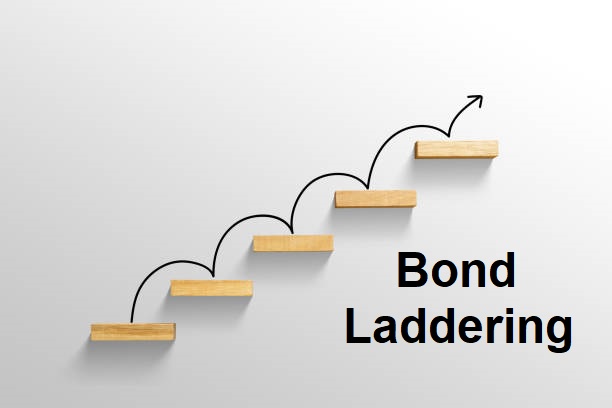
BOND LADDERING Bond investing is much like a game of musical chair in which bond prices move to the tune of interest rates. Sometimes you might feel that you have no control over what happens to your bond portfolio with the future movements in interest rates. But familiarity with ‘bond laddering’, an investment strategy, could help deal with what is called reinvestment risk. How Bond Laddering Works A bond investor might purchase both short-term and long-term bonds in order to disperse the risk along the interest rate curve. That is, if the short-term bonds mature at a time when interest rates are rising, the principal can be re-invested in higher-yield bonds. If interest rates have hit a low point, the investor will get a lower yield on the reinvestment. However, the investor still holds those long-term bonds that are earning a more favourable rate. Essentially, bond laddering is a strategy to reduce risk or increase the opportunity of making money on an upward swing in interest rates. In times of historically low interest rates, this strategy helps an investor avoid locking in a poor return for a long period of time. However, The face value of each bond might be same. For example, a bond portfolio of Rs10 lakh may have 10 different bonds of Rs1 lakh each maturing after one year, two years, three years and so on. In such a situation, your bond portfolio would actually look like a ladder in which every year some of your bonds would be maturing, generating a steady cash flow. This cash flow, if you so like, can be reinvested again to create another rung of a bond ladder. style=\”text-align: justify;\”This kind of strategy ensures that your entire bond portfolio does not mature on the same date. Rungs By taking the total amount you plan to invest and dividing it equally by the total number of years for which you wish to have a ladder, you will arrive at the number of bonds for this portfolio or the number of rungs on your ladder. The greater the number of rungs, the more diversified your portfolio will be and the better protected you will be from any one company defaulting on bond payments. Height of the Ladder The distance between the rungs is determined by the duration between the maturity of the respective bonds. This can range anywhere from every few months to a few years. Obviously, the longer you make your ladder, the higher the average return should be in your portfolio since bond yields generally increase with time. However, this higher return is offset by reinvestment risk and the lack of access to the funds. Making the distance between the rungs very small reduces the average return on the ladder, but you have better access to the money. Well, reinvestment risk of a bond is something that arises due to future movements in interest rates. Other Benefits of Bond Laddering Bond laddering offers steady income in the form of those regularly occurring interest payments on short-term bonds. It also helps lower risk, as the portfolio is diversified because of the various maturation rates of the bonds it contains. In effect, laddering also adds an element of liquidity to a bond portfolio. Bonds by their nature are not liquid investments. That is, they can\’t be cashed in at any time without penalty. By buying a series of bonds with different dates of maturity, the investor guarantees that some cash is available within a reasonably short time frame. Bond laddering rarely leads to outsized returns compared to a relevant index. Therefore, it is usually used by investors who value the safety of principal and income above portfolio growth. It is a lot like ‘not putting all your eggs in the same basket’. Likewise, your entire bond portfolio should not mature on the same date. To Sum Up What: Bond laddering is an investment strategy that tries to minimize the risk associated with the future movement in interest rates. How: A bond portfolio using laddering would consist of bonds having same face value maturing on different dates at a regular interval. Why: Bond laddering strategy is useful because it helps in minimizing the reinvestment risk.

Bond Laddering Read More »