Mutual Fund

Index Fund

An index fund is a portfolio constituted of stocks belonging to some market index such as the Sensex or Nifty. You can invest in an index fund either through a mutual fund or an exchange-traded fund (ETF). Now… The Sensex, as you may be aware, consists of 30 stocks in proportion to their free-float market capitalization. Likewise, Nifty consists of 50 stocks in proportion to their free-float market capitalization. These stock market indices help us in gauging the overall mood of the market because they capture the price movements of most stocks by market capitalization belonging to different sectors. An index fund tries to track a particular index by including all stocks belonging to that index in its portfolio in the same proportion as used by that index. Okay, but how does it work? Say, for instance, if one stock has a weightage of 9.65% on the Nifty, then an index fund tracking the Nifty would use 9.65% of its funds to buy that stock. If another stock has a weightage of 7%, then the index fund would allocate 7% of its funds for buying that stock. The result is that you have a diversified portfolio, consisting of some of the best-known firms, and your portfolio mimics the rise or fall of the chosen index. What are the other advantages of an index fund? The main advantage of an index fund lies in its cost. Since index funds require only passive fund management, they are much cheaper than more actively managed funds in which portfolio managers try to choose the right stock. The expense ratio, which represents the value of total expenses as a percentage of the value of total assets under management, of most of the index funds in India is usually less than that of more actively managed funds. What about its disadvantages? One of the drawbacks which some of the index funds suffer is in the form of tracking errors. Theoretically, the return produced by an index fund should closely mimic the rise or fall of the concerned index. But due to what we call tracking errors, the fund may sometimes generate a return higher or lower than the actual movement in the index. Tracking errors could happen due to a variety of reasons. Let me quickly tell you about some of them… First, some discrepancies might creep in at the time of allocation of funds itself, leading to greater or lower allocation of funds in different stocks. Second, any change in the composition or weightage of the index requires rebalancing of the portfolio by the fund manager, which increases further the scope for discrepancies. Third, it is often difficult for fund managers to trade at the market closing price, which means that the final value of the index and the value of the index fund portfolio on that day might show some difference. Finally, the fund managers may have to keep some cash ready to take care of redemptions by investors. Spare cash reduces the overall return of the fund. To Sum Up What: An index fund tries to track a particular index so that its returns mimic the rise or fall of that specific index. How: An index fund includes all the stocks of a particular index in its portfolio in the same proportion as used by the index. Why: Index funds are popular due to lower expenses and better performance.

Index Fund Read More »

Balance Fund

Our work demands often leave us with little or no time to spend with the family. This routine can lead to unwarranted stress and fatigue. Both work and family are the cornerstones of life, neither of which can be ignored. That is why we need to strike a right balance between work and personal life to lead a happy and a healthier life. Balancing both aspects of your life means, you have to give yourself equally so that one will not suffer at the expense of the other. In the long run, the joy, happiness and fulfillment derived from both are worth the effort. Investing in balanced funds (also known as Hybrid funds) is not much different. Equity and debt as an asset class have equal role to play in creating long-term wealth. EQUITY provides the opportunity to grow capital through stock price appreciation and dividends, while DEBT portfolio brings in the stability through fixed income (interest) and capital gains on bond prices. Similar to work-life balance, balanced funds are here to give us the best of both worlds. Before we learn about balanced funds, let us first understand how are mutual fund schemes classified? Mutual fund schemes are classified by the type of investments they own. An EQUITY FUND primarily invests in stocks. A DEBT FUND invests in bonds or fixed interest bearing instruments. A BALANCED FUND invests in a mix of both – Equity & Debt. What are Types of balanced funds? Balanced funds can be broadly classified into two types: Equity-oriented balanced funds These hybrid funds invest at least 65% of their corpus in equity and equity-related securities. The remaining corpus is invested in debt instruments or even money market investments to provide stability during volatile market conditions. Debt-oriented balanced funds These hybrid funds invest at least 65% of their total corpus in debt securities. The debt component of the scheme includes investments in fixed-income instruments such as treasury bills, debentures, bonds, government securities, and so on. Some part of the fund could also be invested in cash and cash equivalents to give it a liquid component. Why balanced funds? The EQUITY PORTION provides an opportunity to participate in the equity markets. The DEBT PORTION strives to generate stable income through interest income. The mix of Equity & Debt offers lower volatility as compared to other equity schemes since the debt portfolio provides stability of income. An equity oriented balanced fund usually keeps its equity allocation between 65% to 80% thus enjoying the tax benefit of long-term capital gains tax, if held for more than 365 days. A Balanced fund frequently rebalances its portfolio to maintain the equity-debt asset allocation leading to profit booking offered by upward market movements in either stock markets or debt markets. A Balanced fund is ideal for those who want to benefit from the stock market but don\’t have the appetite for volatility. Balanced funds also bring the following advantages: Some investors don\’t want to invest in different funds. What they want is a single, all encompassing choice that they can invest regularly. A well managed balanced fund provides a cushion to the returns generated when the stock market falls, the bonds tend to hold their value better, and when the stock market rises, bonds yields are typically lower. This combination of equity and debt serves well for those investors who don’t have the appetite for risk associated with an equity fund.  

Balance Fund Read More »

Target Maturity Fund

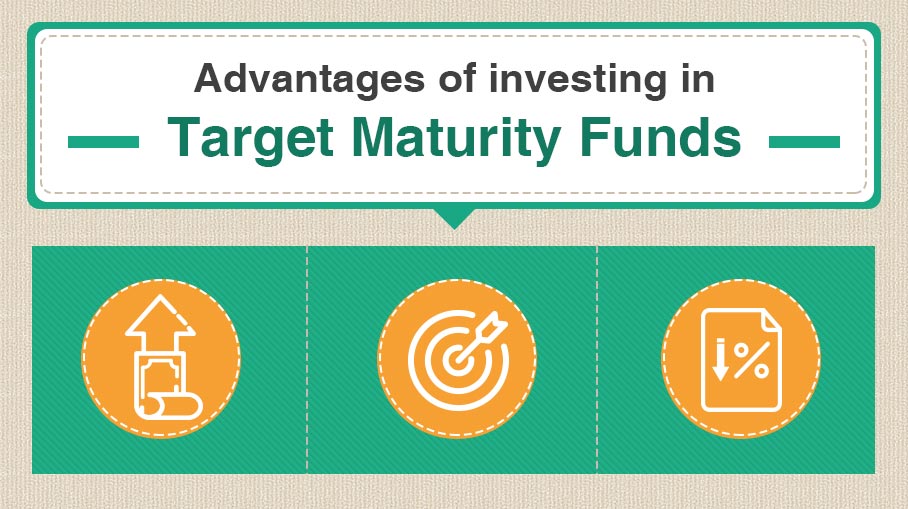
Target Maturity Funds a type of debt fund in bonds of defined maturity, have gained in popularity as a higher-return safe investment. It consists the fund’s benchmark index, such as Nifty PSU bond or the Nifty SDL (State Development Loans) Index. These Funds are high in credit quality, but unlike bank fixed deposits, they are not immune to interest rate risk. Such type of funds, carry lower interest rate risk and provide more predictive and stable returns. These funds have no default risk since the investment is in government securities and highly rated bonds of public sector companies. Are target maturity funds an alternative to fixed deposits? You can invest in target maturity funds if you fall in the higher income tax brackets. It is taxed similarly to debt-oriented funds. You may invest in target maturity funds instead of fixed deposits only if it matches your investment objectives and risk tolerance. You may avoid these funds if you cannot hold them until maturity or fall in the lower income tax bracket. Target maturity funds are a passive investment in bonds of a similar maturity constituting the fund’s benchmark index, such as the Nifty PSU bond or the Nifty SDL. It is an open-ended debt scheme with a specified maturity date.

Target Maturity Fund Read More »

Top Down & Bottom Up Approach

Top Down and Bottom Up style of investing is one of the most common terms used in fund management. Let’s look at an example. Let’s say Tim is a US based businessman wanting to set up a software business. For a software business he would need software engineers. So, instinctively his mind wanders to India which is known have an abundant supply of software engineers. Once he has decided that it is India which shall be the source of supply of software engineers, he then decides to contact an HR consultant in India to line up people. He then interviews the engineers one by one and makes his selections. In this example his decision to select India as the source of software engineers represented the top-down approach while the detailed selection process involving interviews and references etc. represents the bottom-up approach. A top-down approach is an investment strategy that selects various sectors or industries and tries to achieve a balance in an investment portfolio. The top-down approach analyzes the risk by aggregating the impact of internal operational failures. This approach is simple and not data-intensive. The top-down approach relies mainly on historical data. A bottom-up approach, on the other hand, is an investment strategy that depends on the selection of individual stocks. It observes the performance and management of companies and not general economic trends. The bottom-up approach analyzes individual risk in the process by using mathematical models and is thus data-intensive. This method does not rely on historical data. It is a forward-looking approach unlike the top-down model, which is backward-looking. In the event of fund management similarly the fund manager’s decision of investing in emerging markets would represent the Top-Down approach while the detailed selection process of companies based on size, turnover, profitability, management quality etc. would represent the Bottom-Up approach.

Top Down & Bottom Up Approach Read More »

Contra Funds

Contra fund has its genesis in the popular saying, “when others zig you zag”. It basically takes contrasting positions and consciously does not flow with the tide at all times. Let me explain you through a story. There was a boy Jay travelling with his family. They met with an accident in which he lost all his family members. He became orphaned. His relatives turned away from him. Ram a friend of Jay’s father who knew the family was very fond of Jay. He liked him because he was cultured, well mannered, very studious and always a topper in his class. He knew Jay had the talent to become a very successful person. He therefore without any hesitation took Jay under his shelter. He nurtured and educated him sparing no effort. As expected, Jay grew up into a very smart, intelligent and successful person. When Ram started aging and becoming weak it was Jay who stood by him as his shield. He ensured that Ram had all the comforts that he needed. From a Contra perspective one can say that the bet Ram took on Jay was a contra bet. He backed him at a time when others were avoiding him. He did it because he had a clearer understanding of the intrinsic qualities of the boy. He always knew it would be worth his while to help Jay in the long term. Similarly, a Contra fund manager looks for bad news and searches for opportunities within the bad news. He identifies companies being shunned by investors due to overall mood and picks them into his Contra basket. And as we saw in the case of Jay, such companies also may take some time to bounce back. Therefore, as an investor one needs to have patience when investing in a contra theme. The tale of Jay pictorially is Helpless Jay after the accident & Successful Jay once grown up. A contra Mutual Fund invests against the existing market trends and purchases stocks which are not performing well currently. This was the story of Contra investment. Remember it takes patience for the investment to play out.

Contra Funds Read More »

Know Your Customer (KYC)

What is KYC? KYC Means “Know Your Customer”. To invest in any financial instruments, you are required to first provide a few personal details. Customer identification is a key part of system in place to serve many purposes like it can help restrict money laundering and fight financial crime in a more targeted manner. Today, KYC checks are almost compulsory for all financial dealings. Customer is required to submit all KYC documents before investing in various instruments. All financial institutions are mandated by the RBI to do the KYC process for all customers before giving them the right to carry out any financial transactions. Types of KYC There are two types of KYC verification processes. Both are equally good, and it is simply a matter of convenience whether one chooses to opt for one type over the other. Both are as follows:  Aadhar-based KYC: This verification process is done online, making it highly convenient for those with a broadband or internet connection. Here, the customer needs to upload a scanned copy of their original Aadhar card. If the customer wishes to invest in a mutual fund, with Aadhar based KYC the opportunity to do so is only up to Rs.50,000 a year.  In-Person based KYC: If the customer wishes to invest more in mutual funds per year, they will be required to carry out an in-person verification KYC which is done offline. For offline KYC process, here are the steps to follow, Download the KYC Form Fill in with your details, specifically PAN or Aadhaar Visit the nearest KYC registration agency office (KRA) Submit the form with attached ID and address proof While this process is quite simple, it does require legwork and can take longer too. KYC verification can take up to 7 working days. You can find instructions and guidelines to fill the KYC form and download KYC form from the below link, https://www.camskra.com/CKYC-Individual%20Form.pdf

Know Your Customer (KYC) Read More »

ePayEezz

What is ePayEezz? Investor can register PayEezz electronically through MF Utility (MFU) portal. The investor provides the one-time instruction by electronic mode to their CAN (Common Account Number) registered bank thereby authorising MFU to debit the said bank account for future subscription transactions. What is the difference between the PayEezz and ePayEezz? PayEezz registration is done physically by submitting a physical form while ePayEezz is electronically registered. PayEezz has a maximum limit of Rs. 1 crore while ePayEezz has a maximum limit of Rs. 10 lakhs. ePayEezz is restricted to the banks offered by NPCI, while physical PayEezz can be registered for all the banks. Registration for ePayEezz is 3-4 working days while for physical PayEezz it is 30 days. Are there any charges for registering ePayEezz? MFU does not charge for registration of ePayEezz. However, some Banks may levy charges on the customer for Registration / Transaction. Furthermore, MFU does not charge the investor, whenever they submit any subscription transaction, including Lump Sum, SIP or Schedule Transaction / SPP (Scheduled Purchase Plan) using the registered ePayEezz. What is the benefit of registering for ePayEezz? ePayEezz is a One Time One Place payment mandate from MFU. The investor needs to give the mandate one time, rather than submitting in every fund house where they want to invest. As ePayEezz is registered with MFU, the same mandate can be used to make payments for Lump Sum/SIP/ Schedule Transaction / SPP subscriptions across the industry. Do I need to register ePayEezz separately for each Fund Houses? MFU operates on the principle of Aggregation to offer convenience of transaction execution to the mutual fund investor. The same principle is applied even in the case of ePayEezz. Once an ePayEezz is registered with MFU, then it can be used to make payments for investing across the industry. There would be no need to register separate payment mandates for each Fund House.  Can I use the ePayEezz for making payments for lump sum subscriptions? Yes. Once an ePayEezz is registered against a bank account under the CAN, the investor can use the same, to make payments towards Schedule Transaction / SPP, SIP instalments, and Lump Sum subscriptions. Within how many days will the ePayEezz be registered? The time limit stipulated by National Payments Corporation of India is 72 hours for each of the Bank in NACH system i.e. destination Bank (Customers Banks) and the Sponsor Bank (Transaction /Mandate originating Bank) for processing the mandate. However, the actual turnaround time may vary. What is ePayEezz Reference Number (PRN)? PRN is the unique mandate reference number allotted upon completion of ePayEezz registration. What are the various transactions that I can use ePayEezz for payment? An ePayEezz once registered can be used for making payments against any subscription such as Lump Sum purchase, Schedule Transaction / SPP, SIP, across any fund house on the MFU Portal. On which bank accounts can I register for ePayEezz? An ePayEezz can be registered only on the bank accounts that are registered in the CAN and such CAN registered banks are offered / by NPCI.

ePayEezz Read More »

PayEezz

What is PayEezz? PayEezz is a facility offered by MF Utility (MFU) through which an investor can register one-time mandate. Investor provides a standing instruction to his banker authorising MFU to debit his account for any future subscription transactions such as SIP or Lumpsum. What is the benefit of registering under PayEezz? By registering under PayEezz, investors need not issue cheque or other payment instructions every time they make an investment through MF Utility up to the amount mentioned in the PayEezz mandate.  This brings ease and convenience in subscribing for mutual fund units through MFU. This will also enable you to transact paperless. PayEezz can be registered by submitting the PayEezz form at the time of CAN (Common Account Number) creation. What are the documents required to register PayEezz? No additional documents are required to register PayEezz, investors should submit a cancelled cheque (or a self-attested photocopy of cheque) with the name and the account number pre-printed on the cheque along with the PayEezz form. If the cheque does not bear the sole/first/primary holder’s name, a copy of the passbook/bank account statement or a letter from the banker has to be submitted which indicates that the sole/first/primary holder is one of the account holders in the account. Are there any charges for registering PayEezz under CAN? There are no charges for registering PayEezz at MFU. However, some banks may charge the customer for registration / transaction at the banks end. How many PayEezz registration can be made under a CAN? Investor can have as many PayEezz registrations as they wish under a CAN. PayEezz can be registered only in a bank account which is registered under a CAN? Within how many days will the PayEezz be registered? Depending upon the investor’s bank mentioned in the PayEezz, it may take anywhere between 10-30 days to get the PayEezz registered. How will the investor/distributor come to know about the successful registration of PayEezz? A communication will be sent from MFU to the investor/distributor via email and/or SMS upon successful registration of the PayEezz informing the PayEezz Reference Number (PRN). What is PRN number? PRN (PayEezz Reference Number) is the unique reference number allotted to each PayEezz registration. The same will be communicated to the investor/distributor upon successful registration of the PayEezz. Can we cancel/modify the PayEezz and what is the process? Investor can submit a PayEezz cancellation / modification request and MFU will do the needful. When can the investor start transacting using the PayEezz facility for payment? Investors can start transacting using the PayEezz immediately after they get a PRN from MFU. What are the various transactions that an investor can use PayEezz for payment? All subscription transactions, both lump sum and SIP are enabled with PayEezz. Is there any amount limit for transacting using the PayEezz? The total transaction amount in a form should not be more than the limit specified in the PayEezz. Do I need to authorize every payment using PayEezz? Yes. Where a transaction is initiated by your distributor / RIA, an authorization is sought for every payment using PayEezz, by way of an email and/or SMS to the email ID and mobile number registered under your CAN. Please ensure both email ID and mobile number are registered under your CAN and kept up to date at all times. Where the transaction is initiated by you by way of signing a transaction form or otherwise, such confirmation is not sought for. Can the distributors / RIAs register PayEezz through their login? The distributors / RIAs will have a facility to register the PayEezz through their logins. The original PayEezz form has to be submitted to the mapped POS branch as usual along with the other documents. The registration process will be initiated only upon receipt of the original PayEezz form by MFU POS.

PayEezz Read More »

MF Utility

What is MF Utility? The Association of Mutual Funds in India (AMFI) has started a single-window Platform, which acts as a “Transaction Aggregation Portal” through which a Mutual Fund customer is enabled to transact in multiple schemes across Mutual Funds using a single form/payment. It’s a “Shared Services” initiated by AMFI subsidiary MF Utility India Pvt. Ltd. MF Utility (MFU) is a browser-based application that connects investors to registrars and transfer agent (RTA), banks, fund houses, payment gateway and know your customer (KYC), or KYC registration agencies (KRA). MF Utility (MFU) is operated by MF Utility India Private Limited (MFUI) which is equally owned by participating AMC’s. What is CAN? Common Account Number is an industry level Folio allotted by MF Utility to an Investor. It is the combination comprising of the following, Number of Investors – i.e., 1 or 2 or 3. Order of holding – i.e., No of holders. Mode of holding – i.e., Single, Joint and Anyone or Survivor. Social Tax Status – i.e., Individual, Company, Non-Resident, etc. What are the different transactions enabled through MF Utility? Common Account Number (CAN) registration for Investors. Submission of documents to KRAs for KYC Registration for those investors who are seeking CAN creation. Commercial Transactions like Purchases, Redemptions and Switches. Registration of Systematic Transaction Plan (SIP), Systematic Withdrawal Plan (SWP) and Systematic Transfer Plan (STP). Non-commercial transactions (NCT) like Bank Account changes, facilitating change of address through KRA’s etc. based on duly signed written requests from the investors. What are the features of MF Utility? MF Utility (MFU) provides a whole lot of features to the Mutual Fund customers like:- Provides Common Account Number (CAN) facility to Investors. Provides standardization of forms, processes and MIS across the industry. Provides multiple modes of access and transaction submission options. Provides broad and neutral Points of Service (POS) footprint for enhanced coverage. Enables transactions through a common transaction form. Enables single payment for multiple scheme investments across various Mutual Funds. Provides CAN based consolidated view of investments across the industry. Provides industry level alerts, triggers, reminders etc. Provides a centralized complaint management and tracking system. MF Utility (MFU) is an innovative initiative of the Indian Mutual Fund Industry that brings significant benefits to all stakeholders, i.e., Investors, Distributors, Registered Investment Advisors (RIA’s) and Asset Management Companies, by leveraging technology, MFU has brought many conveniences to the investors and distributors /RIA’s and allowed Mutual Funds to significantly enhance their reach and presence in the country to further the goals of retail penetration. MFU has helped remove duplicities in the system and reduce the inherent risks in the industry.

MF Utility Read More »

Hedge Fund Vs Mutual Fund

Hedge funds are like mutual funds in some ways. Investment professionals in a hedge fund pool in money from investors to be managed,  exactly like the mutual funds do. And, subject to some minor restrictions, investors in hedge funds can withdraw their money as they can in a mutual fund. Nothing else is similar. In India a number of large hedge funds operate as Foreign Portfolio Investors and these include names like Amansa, Helios etc. The world of mutual funds is much simpler while the world of hedge funds is a lot more esoteric. Let us understand how are hedge funds different from mutual funds? Hedge Funds Focus on absolute returns. Mutual Funds Focus on relative returns. Returns should be higher than benchmark. Hedge Funds Can invest in any asset class – stocks, bonds, commodities, real estate, private partnerships, – or exotic debt products like packaged sub-prime mortgages. Mutual Funds Work within a risk controlled and compliance framework set up by the regulator. Hence very risky asset classes are prohibited for investment. Mutual Fund is essentially a trust which pools the savings of millions of small and medium sized retail investors. Hedge fund, on the other hand, is a portfolio of investments in which only a few wealthy and qualified investors are allowed to invest. Hedge Funds can borrow to bet bigger and enhance returns. Mutual Funds can borrow – but within SEBI guidelines. Hedge Funds can run highly concentrated portfolios. Mutual Funds objective is to protect investors’ investment and hence diversification is the key principle. Hedge Funds is meant for those who are already rich. Hedge funds are open only to \’accredited investors\’ defined as those with big net worth, or income in each of the past two years. Mutual Funds is meant for people at large providing them with an option of building wealth through equity and debt investments. Mutual Funds allow even small investors to participate. Hedge Funds are virtually unregulated. Mutual Funds are heavily regulated because investor safety is the most important requirement. Hedge Funds cannot market themselves publicly. Mutual Funds are sold as products to enhance wealth.

Hedge Fund Vs Mutual Fund Read More »